Filtrer les résultats
 Guerino Ruba
Bronze
Collection: Musée du Bas-Saint-Laurent
Cégep de Rivière-du-Loup, entrée des résidences au 325, rue Saint-Pierre - Inaugurated in 2003
Born in Pola, Italy (now Pula, Croatia), in 1940, Guerino Ruba moved to Montréal in 1967, where he studied sculpture at the Université du Québec à Montréal. He went on to teach in the Fine Arts Department at Cégep du Vieux Montréal until 2004. A committed and uncompromising artist, Ruba creates powerful works that confront the darker side of humanity. War, cruelty and death are recurring themes in his work.
The Giocolieri series, comprising Giocoliere I, II and III, references the figure of the jester, the entertainer of royalty. Meaning “jugglers” in Italian, Ruba’s giocolieri blend circus imagery and Italian commedia with allusions to the French Revolution, an extremely violent time that saw the fall of the absolute monarchy.
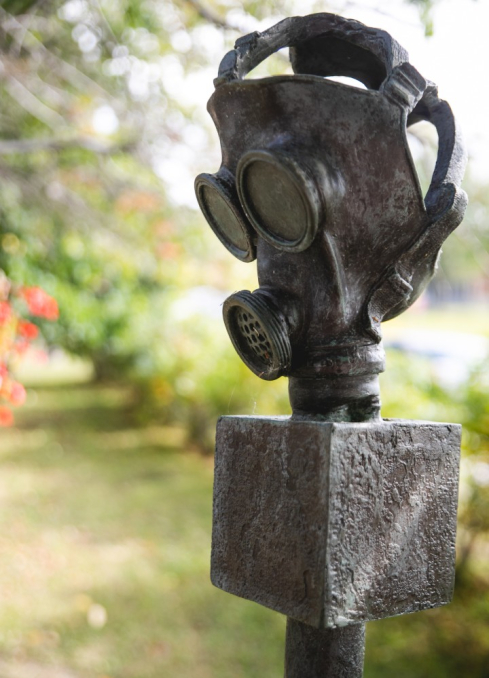
Facing Giocoliere II and III, Giocoliere I stands out for its specific motifs. A crown resting on a throne is set atop a rectangular form reminiscent of a guillotine. In front of this royal symbol, two strange juggling figures appear frozen mid-performance: one with a face brutally slashed, the other wearing a gas mask.
If this sculpture were telling a story, what would it be?
 Denis Beauséjour, Youri Blanchet et François Maltais
Torrified wood, Painted metal
Collection: Cégep de Rivière-du-Loup
Cégep de Rivière-du-Loup, coin rue Saint-Pierre et rue Frontenac - Inaugurated in 2021
Through their individual artistic practices and careers teaching at the Cégep de Rivière-du-Loup arts department, artists Denis Beauséjour, Youri Blanchet and François Maltais actively contribute to enriching the regional cultural landscape. Together, they created the sculpture Se tenir debout et rayonner, aimed at highlighting the pivotal role of the Cégep since its founding in 1969.
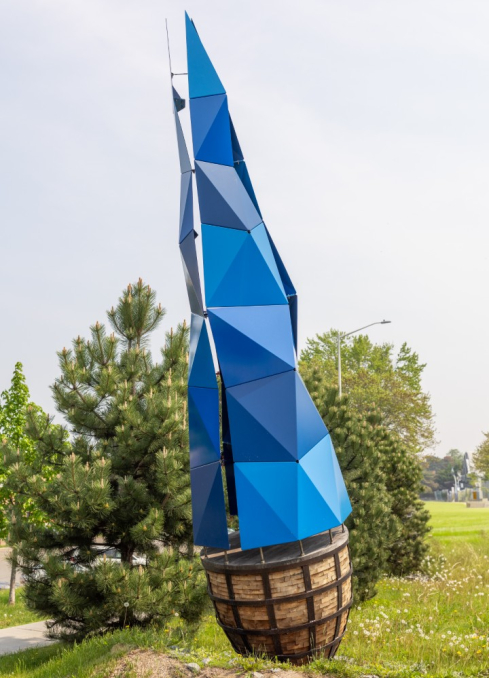
Slightly tilted, the work consists of an oval shape that stretches toward the sky in a striking geometric trail. It resembles a buoy guiding ships, also symbolizing the beacons offered by education. The surrounding landscaping mimics the undulating motion of a wave, giving the structure a sense of floating. The installation thus links learning with the river that defines the Cégep’s environment.
Reflecting the spirit of camaraderie that permeates the institution, Se tenir debout et rayonner references the origins of the Cégep, which was established through community mobilization. The verticality of the piece also evokes the personal and collective growth sparked by education. Anchored in the past yet reaching toward the future, the sculpture not only testifies to the socio-economic and cultural significance of this college, but also highlights its deeply collaborative nature.
The artists drew inspiration in part from a maritime buoy. What connections do you see between education and a buoy?
 Charles Daudelin
Corten steel
Collection: Ville de Rivière-du-Loup
Centre Premier Tech, 75 rue Frontenac - Inaugurated in 2006
Born in Granby, Charles Daudelin (1920–2001) moved to Montréal in 1939, where he studied at the École nationale du meuble, notably under the tutelage of Paul-Émile Borduas. A pioneer in integrating art with architecture, Daudelin paved the way for monumental sculpture in public spaces. He dedicated his life to creating public art projects that fostered connections with people and generated collective spaces, a commitment he maintained until his death.
In the 1980s, the sculptor explored the technique of folding, creating several models based on this theme, which enabled him to shape materials and breathe life into his sculptures. In 1986, he created Émérillon, a small-scale brass sculpture that served as a trophy for the France-Canada cinema and audiovisual awards. In 2005, the Ville de Rivière‑du‑Loup acquired a larger version made of steel.
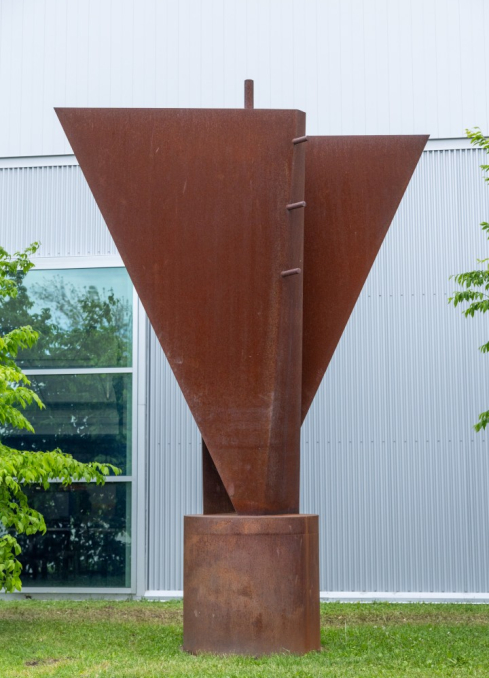
Émérillon in French refers to the small Merlin falcon, envisioned here with its wings unfurled, also evoking a sailing boat. The piece reflects Daudelin’s artistic interests in geometry, the interplay between voids and solids, and the balance between instability and equilibrium. Revealing the clear folds of the original model, this large sculpture stands as a remarkable example of Daudelin’s distinctive volumetric style.
Move around the sculpture to see both the wings of a falcon and the sails of a boat.
 Cooke-Sasseville
Painted metal
Collection: Ville de Rivière-du-Loup
Stade de la Cité des jeunes 75, rue Frontenac - Inaugurated in 2021
Artists Jean-François Cooke and Pierre Sasseville have been working together under the name Cooke-Sasseville since 2000. Their artistic practice is defined by the unlikely pairing of often mundane elements, whose meaning and function are subverted through shifts in scale and striking scenography. The duo creates a body of work infused with humour, rooted in Quebec’s distinct identity, and peppered with nods to popular culture and political or economic current events.
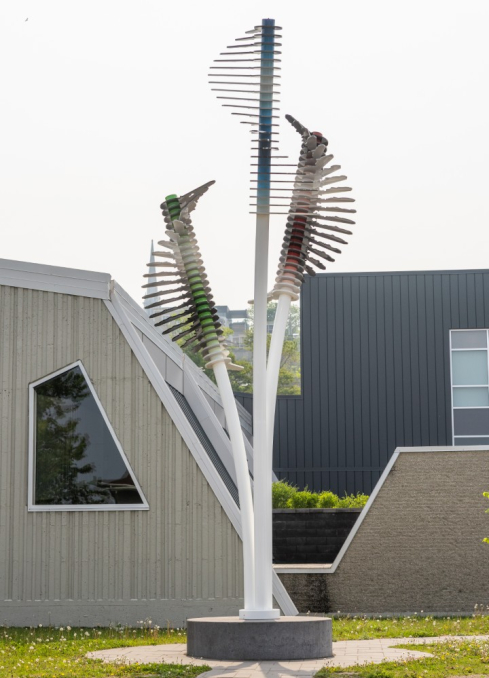
The sculpture Jeu de clés consists of three masts topped with an array of keys arranged in a fan shape. By definition, a key (the word clé, in French) is used to lock or unlock. It also features in many everyday expressions, such as “the key to the problem,” where it symbolizes a solution. The expression “turnkey” suggests that everyone possesses the tools they need to thrive.
In Jeu de clés, each key represents the profile of a human face. These many anonymous figures, cut into the bit—the part of the key used to lock or unlock—underscore the importance of each individual’s role within a social whole. Without the bit, all keys would be identical; it is this detail that makes each one unique.
Each mast in the sculpture displays a cluster of keys, each cut with a unique profile. What might this piece represent?
 Gilles Girard
Brushed aluminum
Collection: Centre de services scolaire Kamouraska-Rivière-du-Loup
Pavillon-de-l’Avenir, entrée rue Landry - Inaugurated in 1996
Originally from Price and now based in Matane, sculptor Gilles Girard holds a Bachelor of Fine Arts degree from Université Laval in Québec City. Constantly in search of graphic elegance in space, he builds sculptural creations inspired by animal forms and marked by dynamic lines.
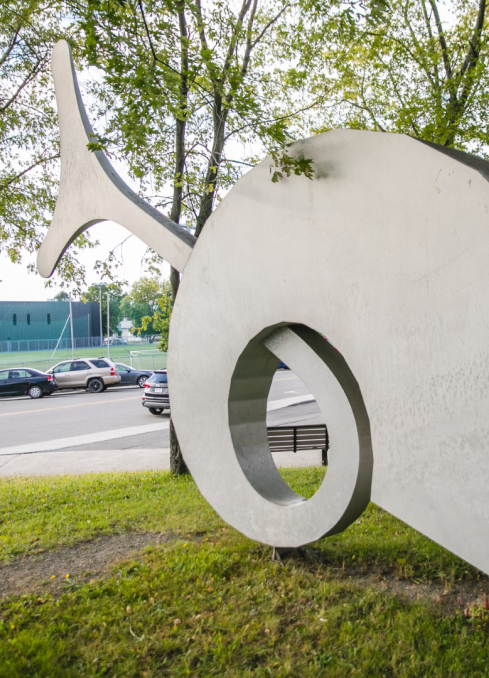
Croissance, développement, devenir unfolds in a gigantic spiral whose upper tip reaches skyward. The structure resembles a massive snail, bearing a rounded shell and stretching out its antennae. Despite the mollusc’s reputation for slowness, the work is full of movement; it seems to be launching itself forward at full speed. The resulting image is a curious contradiction, combining opposing concepts: the animal’s inertia and the spiral’s dynamic design, the limpness of a soft body and the rigidity of metal, the mineral mass of the shell and the lightness of aluminum.
The sculpture Croissance, développement, devenir stands in stark contrast to its surroundings, yet manages to harmonize with the natural ecosystem in which it is set. Part of a body of work inspired by the animal world and fuelled by imagination, the piece reflects the artist’s fascination with creatures of all kinds. It contributes to the creation of a strange bestiary, one in which the giant snail undoubtedly holds a unique place.
Which elements of the sculpture symbolize growth? Which ones represent development and becoming?
 Yves Trudeau
Welded bronze
Collection: Centre de services scolaire Kamouraska-Rivière-du-Loup
Pavillon-de-l’Avenir, entrée rue Sainte-Anne - Inaugurated in 1968
Born in Montréal, Yves Trudeau (1930–2017) began studying art as a teenager and launched his sculpting career in the late 1950s. Actively involved in several professional organizations, he was a founding member of the Association des sculpteurs du Québec, playing a key role in the creation of the Musée d’art contemporain de Montréal.
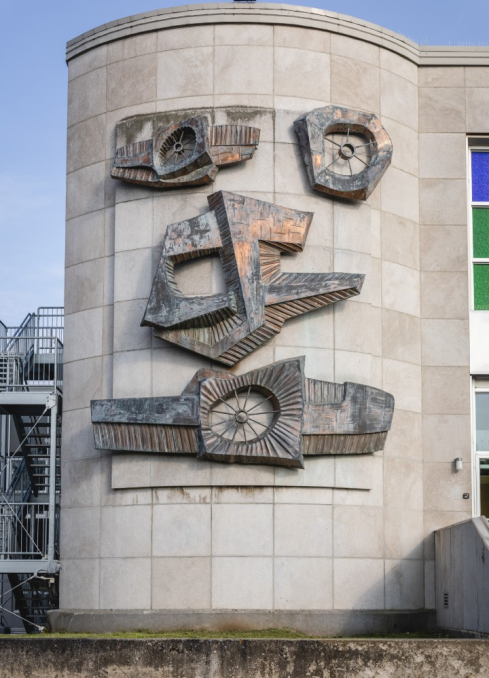
Reliefs is an installation made up of five large-scale units arranged in a way that suggests a face. Towering in scale, the figure protrudes from the curved facade while blending seamlessly with the building’s architecture. The texture and shape of the modular elements recall the distinct features of a mouth, nose and two eyes. The work reflects Trudeau’s interest, during this period, in incorporating human references into his practice.
In the 1960s, he began exploring the idea of mobility through static forms. The recurring motif of wheels or gears in Reliefs expresses the tensions he sought to create between movement and stillness. The installation also reveals some of the concerns that would shape his later work, such as the relationships between container and contained, interior and exterior, openness and enclosure, inclusion and integration.
Besides a face, what else could the arrangement of components represent?
 Émilie Rondeau
Cut, engraved and painted anodized aluminum, galvanized steel, digital print
Collection: École de musique Alain-Caron
École de musique Alain-Caron 75, rue Sainte-Anne - Inaugurated in 2010
Originally from Saint-Hyacinthe and now based in Rivière-Ouelle, artist Émilie Rondeau holds a Bachelor of Fine Arts degree from Concordia University in Montréal and a Master of Fine Arts degree from the Nova Scotia College of Art and Design in Halifax. Through processes aimed at distorting the senses and blending references, she creates dreamlike works that combine the real and the imaginary.
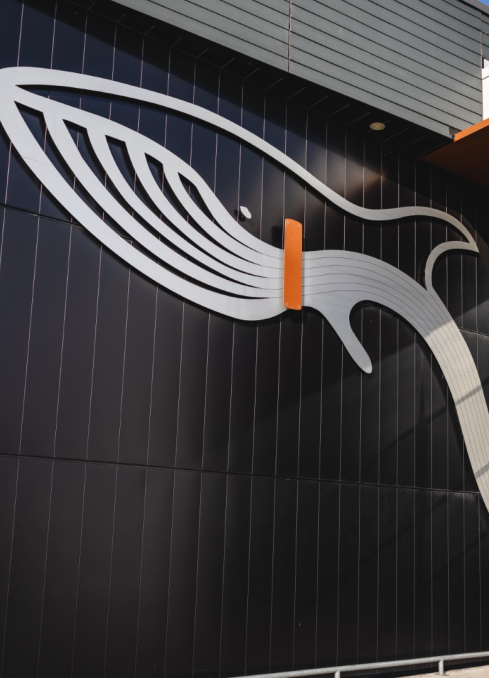
Vocalises d’une baleine à cordes merges the silhouette of a fin whale, present in the St. Lawrence Estuary near Rivière-du-Loup, with the iconic bass guitar of jazz musician Alain Caron, a native of Saint-Éloi, after whom the music school where the sculpture stands is named. Reflected by the mirrored effect of the building’s glass entrance, the curves of the whale's body blend playfully with those of the stringed instrument. Inside the building, the neck of the guitar extends into a panoramic landscape representing the view of the river and the mountains facing the city.
The undulating lines throughout the piece echo the musical compositions of the bassist and the role of the École de musique Alain-Caron, as well as the whale's song and the river’s ripples. Reimagining the surrounding environment, the "stringed whale" encourages us to see our surroundings in a new light.
Did you know this artwork continues indoors? Feel free to step inside to experience the full piece.
Set out on foot or by bike to discover some 40 works of art installed all around Rivière-du-Loup. This impressive collection brings together pieces by some of the biggest names in Canadian art.
Intervalle is an invitation to pause and awaken your senses during moments of stillness in the urban landscape.
Explore the trail on your own or join one of our guided walking tours, which leaves the Musée every Sunday at 11 a.m.!
$15 + tax. 5$ for kids (Free for children under 5).
(The fee also includes admission to the Musée.)
Guided Tours
The tour includes artworks in the Parc de la Pointe linear riverside park and a snack at the Café culturel de la Pointe. Maximum of four adults per tour, ages 18 and up.
Schedule and prices:
Saturdays 1:30–4:30 p.m. $45 + tax
Click HERE to book the 3-hour tour (via the De la Pointe Park)
Pick up a printed map of the Intervalle itinerary at the Musée du Bas-Saint-Laurent or the Rivière-du-Loup tourist information office.
To learn more, visit the Musée du Bas-Saint-Laurent or visit our website at mbsl.qc.ca.
.png)