Filtrer les résultats
 Henry Saxe
Welded steel
Collection: Musée du Bas-Saint-Laurent
Jardins du Musée - Inaugurated in 2001
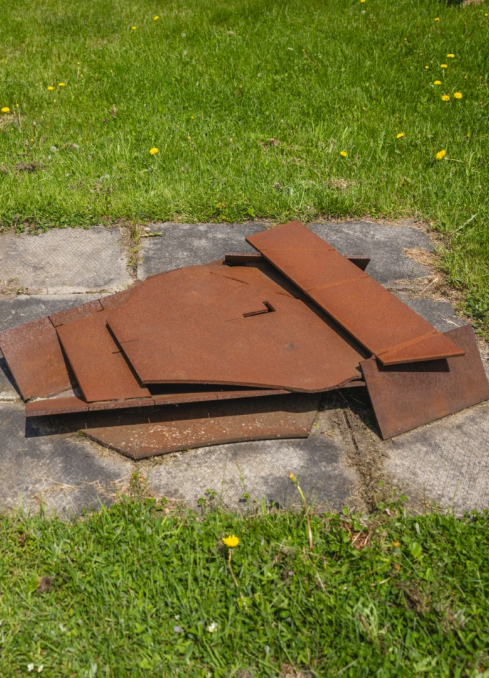
Born in Montréal in 1937, sculptor Henry Saxe attended Sir George Williams University from 1955 to 1956, before enrolling at the École des beaux-arts de Montréal, where he studied from 1956 to 1961. In 1973, he moved to Tamworth, Ontario, where he built a studio that allowed him to experiment with new tools and explore the creation of complex structures.
Model of a Distant Model reflects the artist’s ongoing exploration of accumulation and horizontality, recurring themes in many of his public artworks from the late 1970s. Stretching low across the ground, the piece is composed of multiple elements arranged in a way that resembles a scale model. It channels Saxe’s childhood fascination with machines, airplanes, engines and other mechanical inventions.
With its stacked steel plates layered one atop another, the sculpture simultaneously asserts the physical weight of the material and disrupts the viewer’s perception of three-dimensional space. It prompts us to consider how it was constructed, sparking the imagination and inviting us to mentally complete this mysterious form ourselves.
Focus on the folds and openings in this piece. Imagine it assembled in a different way.
 Robert Roussil
Wood
Collection: Musée du Bas-Saint-Laurent
Jardins du Musée - Inaugurated in 2003
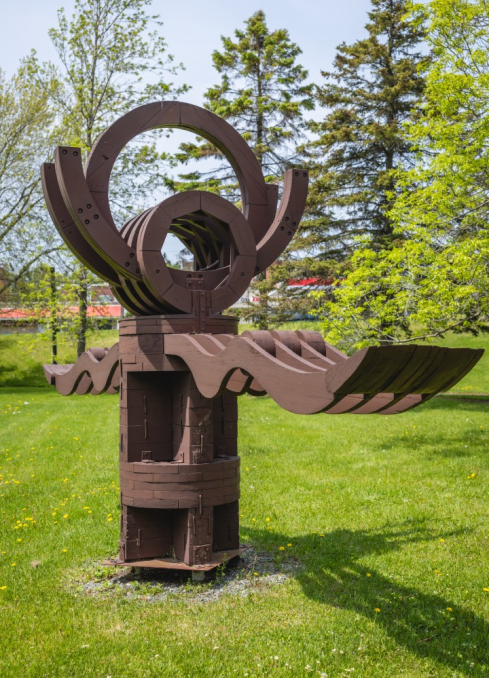
Born in east-end Montréal and later settling in Tourrettes-sur-Loup, France, where he lived from 1956 until his death, artist Robert Roussil (1925–2013) played a key role in the early development of modern sculpture in Quebec. Bold and avant-garde, Roussil consistently challenged the status quo and was a driving force behind Quebec’s artistic liberation, though not without stirring up some controversy along the way. His sculptural practice was grounded in a deep affinity for public space and a visceral love of nature.
Totem ailé reflects the artistic direction Roussil pursued in the 1980s, a period largely focused on experimenting with wood through the creation of modular sculptures. Centred on a stacked ring column, these bold, rounded forms feature offshoots—horns, mandibles, beaks, branches—that playfully conjure both animal and plant life.
The work calls to mind a bird or flying insect. A trunk-like base supports a head-like shape made of circles and half-circles, from which two side elements extend. These wing-like curves ripple outward, as if stirring the air around them. They give the sculpture a striking presence that exudes the raw energy of nature.
What animals or plants does Totem ailé bring to mind?
 Robert Poulin
Painted steel
Collection: Musée du Bas-Saint-Laurent
Jardins du Musée - Inaugurated in 2000
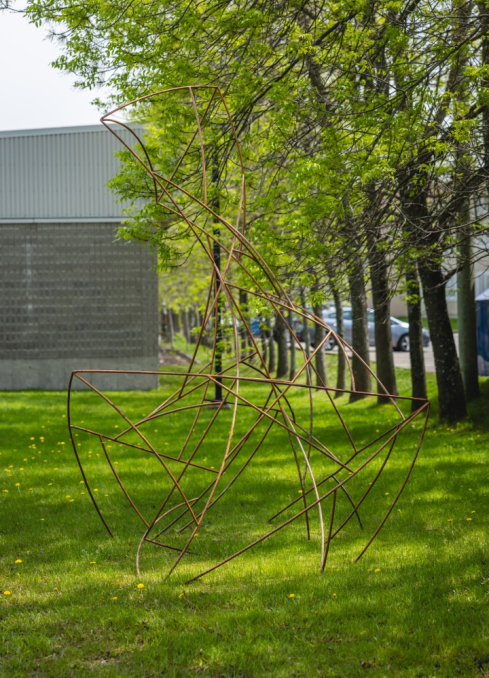
Active as a professional sculptor from 1972 to 1989, Robert Poulin honed his expertise in steelwork in Japan (1974–1975) and then in a factory in Sorel-Tracy (1976–1979), known as “the steel city” from the 1960s to the 1990s. From that point on, he produced numerous slender sculptures made of curved steel rods. After his sculpting career, he went on to specialize as a gallerist and art collector in the visual arts scene.
One of Poulin’s first large-scale works, Sans titre already hints at the airy, linear style that would define his later practice. Painted in red, this arrangement of curved steel pipes is reminiscent of a children’s climbing frame. Its colour and playful configuration lend it a fun, spontaneous feel, like a sketch quickly scribbled on paper.
Despite its pared-down form and minimalist use of materials, Sans titre fills its surroundings with vibrant energy. The sculpture draws on geometric simplicity to create an experience shaped by the strength and harmony of its lines. With Poulin’s surprising bends and twists, the work infuses the space with striking expressiveness, a sudden burst of creativity springing up into the space.
If you were to give this sculpture a title, what would it be?
 Guerino Ruba
Cement, steel, fibreglass
Collection: Musée du Bas-Saint-Laurent
Jardins du Musée - Inaugurated in 2001
Born in Pola, Italy (now Pula, Croatia), Guerino Ruba moved to Montréal in 1967, where he studied sculpture at the Université du Québec à Montréal. He went on to teach in the Fine Arts Department at Cégep du Vieux Montréal until 2004. A committed and uncompromising artist, Ruba creates powerful works that confront the darker side of humanity. War, cruelty and death are recurring themes in his work.
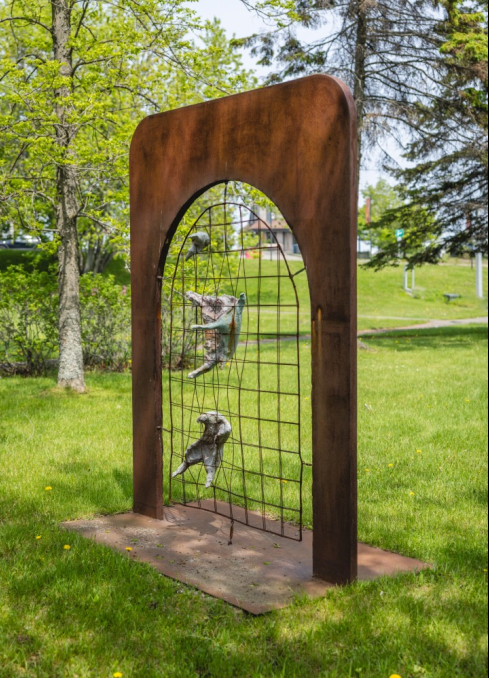
La trappe features an arch within which a wire mesh is stretched. Trapped between the metal wires are organic-looking forms that seem caught in a snare. Their colour and texture evoke animal carcasses, and their silhouettes suggest four elongated limbs, now reduced to stumps. These mutilated bodies stir nightmares lurking in our collective unconscious while also confronting us with the violent realities of the human condition.
Despite its disturbing nature, La trappe is ultimately a call for outrage in the face of the great tragedies of our time. It urges both personal and collective action, awakening our capacity to resist in a world numbed by violence.
What emotions does this piece stir in you, and why?
 Dominique Valade
Aluminum, granite, stones, plants
Collection: Musée du Bas-Saint-Laurent
Jardins du Musée - Inaugurated in 2003
Dominique Valade holds a Master of Fine Arts degree (1994) and a PhD in Arts Studies and Practices (2004) from the Université du Québec à Montréal, where she focused on the reinterpretation of landscapes in sculptural work. In the 1990s and 2000s, she created a series of installations on the notion of the dwelling, exploring a wide array of elements that surround or form the human habitat.
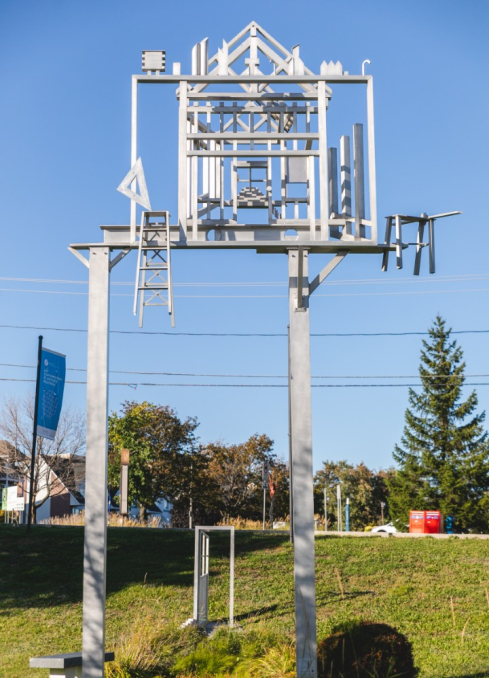
Presented together in a single installation, Habitacle and Projection de l’habitacle invite reflection on the relationship between humans and nature, drawing upon the concept of landscape. Unlike nature, landscape is a human invention, created through framing, composition and perspective. Habitacle consists of two imposing pillars supporting the frame of a house under construction. Surrounded by shrubs and flowers, a pathway leads to another, smaller yet equally evocative structure. Projection de l’habitacle takes the form of a landscape with an open door at its centre.
Through this sculptural ensemble, Valade addresses not only the idea of the home and habitat but also representation, imagination and dreams. She demonstrates, in three dimensions, that landscape exists beyond paintings and is brought to life through our very gaze.
What do you think lies beyond the slightly open door?
 Ulysse Comtois
Painted steel
Collection: Musée du Bas-Saint-Laurent
Entrée principale du Musée - Inaugurated in 2001
Quebec sculptor and painter Ulysse Comtois (1931–1999) studied at the École des beaux-arts de Montréal in the late 1940s, but soon grew disenchanted with its traditional methods, drawn instead to the avant-garde movements of the time. Known for his modular, abstract sculptures, he was one of the first Canadian artists to begin working with welded metal in the early 1960s.
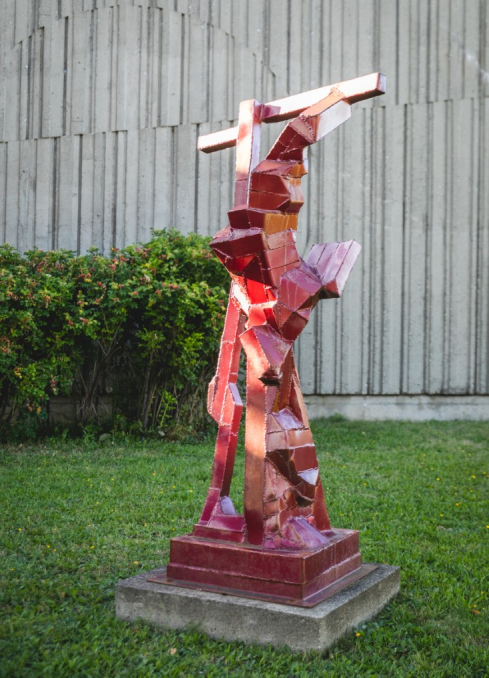
The sculpture Héraut—named after a herald, a figure tasked with announcing the arrival of someone or something—is composed of interlocking geometric and organic shapes that suggest motion. With its mechanized human form, the piece speaks to the relationship between humans and machines. The work’s ambiguity, arising from the blurred line between person and mechanical object, is heightened by the bold red that coats every element, emphasizing the fusion of human and machine within a single sculptural entity.
Welding gave Comtois the freedom to assemble his forms with a dynamic energy that echoes the chaos of the natural world. His explorations of the tensions between order and disorder, freedom and constraint, beauty and ugliness would go on to influence a generation of artists seeking to break away from the conventions of traditional sculpture.
If this sculpture were a person, what would they be doing? And if it were a machine, what might it be used for?
 Bill Vazan
Sandblasted granite
Collection: Musée du Bas-Saint-Laurent
Entrée principale du Musée - Inaugurated in 2004
Born in Toronto in 1933, Bill Vazan studied at the Ontario College of Art and Design, the Beaux-Arts de Paris school and Sir George Williams University in Montréal, where he settled in 1957. Motivated by the desire to bring Montréal and Quebec into an international network, he was instrumental in founding Véhicule Art (Montréal) Inc., a major artist-run centre that showcased contemporary and experimental practices during the 1970s.
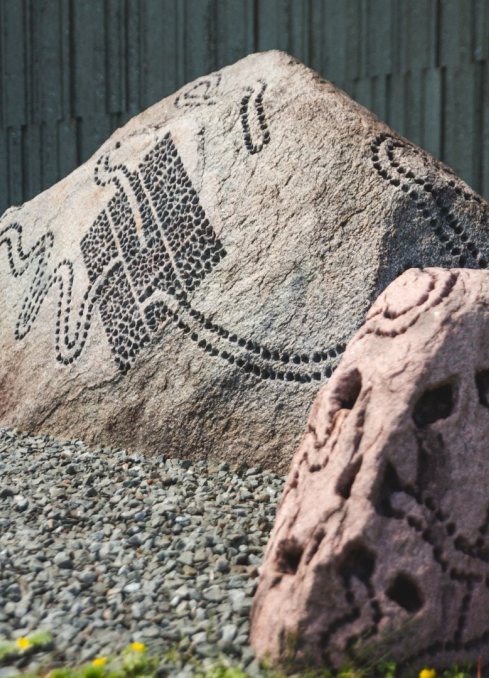
Rooted in the belief that nature and humanity are deeply interconnected, his artistic process draws inspiration from land art—an art movement that began in the 1960s focusing on creating artworks directly in and with the landscape. Throughout his career, Vazan has created an extensive body of carved stone works bearing symbolic motifs. These engravings often reference the marks left by human presence on the land.
The sculptures Grid with Superstrings and Sans titre both feature forms that are simultaneously organic and geometric, evoking the relationship between human beings and the universe. The engraved lines winding across the granite create a kinaesthetic experience that calls to mind the imprint of omnipresent natural forces, as well as the memory of ancient civilizations.
What do the engraved patterns on the granite make you think of?
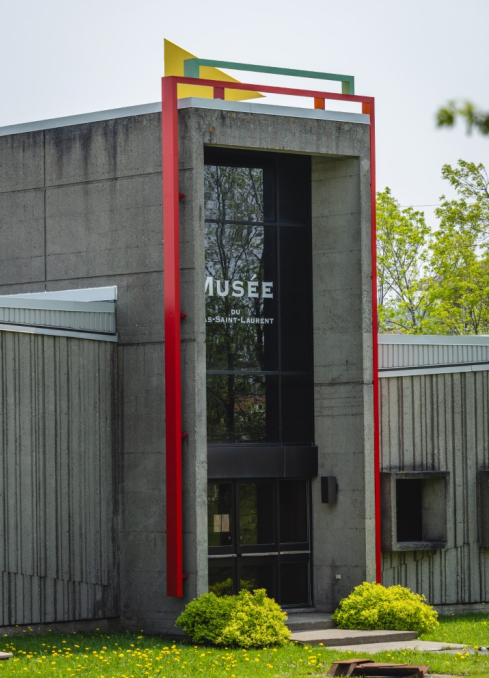 Michel Lagacé
Painted aluminum
Collection: Musée du Bas-Saint-Laurent
Entrée principale du Musée - Inaugurated in 1986
Hailing from Rivière‑du‑Loup, Michel Lagacé holds both a Bachelor’s degree and a Master’s degree in Fine Arts from the Université du Québec à Montréal. He taught at the Cégep de Rivière-du-Loup arts department from 1976 to 2010 and has been actively involved with Voir à l’Est art contemporain, a collective of artists from the Bas‑Saint‑Laurent region, from its inception in the late 1990s. In his artistic practice, Lagacé has a strong interest in shapes and colours, which he expresses through paintings and public art projects.
Located in the main section of the Musée du Bas‑Saint‑Laurent, Signal draws attention to the two entrances of the building. The colourful metal structure, which rises above and frames the architecture, contrasts with the starkness of the concrete exterior through its vibrant colours and geometric lines. The artist designed Signal to highlight the building’s facade, accentuating its openings, which serve as gateways to knowledge.
The work was created in the context of the expansion of the Centre d’animation et de diffusion culturelles du Bas‑Saint‑Laurent, which opened in 1975 under the name Musée d’archéologie de l’Est du Québec and is now known as the Musée du Bas-Saint-Laurent. Signal is part of Lagacé’s ongoing experiments with signs and architecture. Since the 1980s, the artist has explored issues related to signage and the demarcation of spaces. Reflecting the museum’s various missions since its creation, the installation acts as a thread connecting them all, demonstrating the importance the MBSL places on the transmission of knowledge through the ages.
Signal frames the museum’s two entrances. Cross the street to take in the full view.
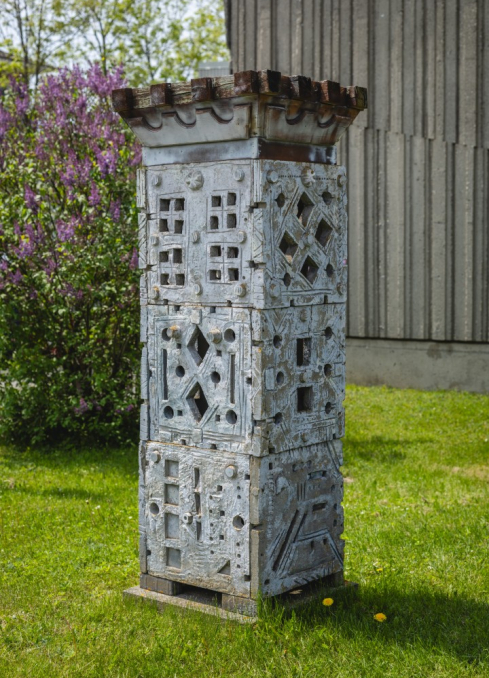 Louis Belzile
Cement, fibreglass, wood
Collection: Musée du Bas-Saint-Laurent
Entrée principale du Musée - Inaugurated in 2000
Originally from Rimouski, painter and sculptor Louis Belzile (1929–2019) studied at the Ontario College of Art and Design in Toronto from 1948 to 1952, then with Cubist painter André Lhote in Paris from 1953 to 1954. He was one of the four signatories of the Manifeste des plasticiens (1955), which advocated for an approach to painting based on formal elements: tone, texture, colour, form and line.
A rare sculptural work by the artist, Les trois âges stands apart from his contemporary painting practice, in which he explored the effects of light. This three-dimensional piece takes the form of a column composed of twelve sculpted concrete segments topped with a moulded wood cap. Its materials call to mind the built environment, referencing architecture and offering a fresh perspective on these familiar elements.
The stacking of openwork panels results in a mysterious structure, somewhere between a small-scale model and an abstract sculpture. True to Belzile’s artistic language, simple geometric forms are used here to create varied openings and textures in the concrete. Although a departure from the artist’s usual medium, Les trois âges offers a compelling insight into the artist’s broader exploration of depth at the time.
Take a close look at how the light plays through the sculpture.
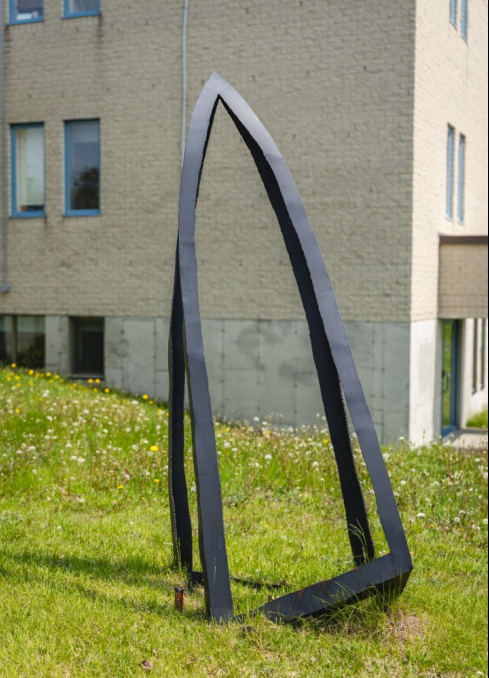 Jean-Pierre Morin
Painted steel
Collection: Musée du Bas-Saint-Laurent
Stationnement du Musée - Inaugurated in 2000
Originally from Saint-Anselme, Jean‑Pierre Morin studied at the École de sculpture de Saint-Jean-Port-Joli (1968–1971), then earned a Bachelor of Fine Arts degree from Université Laval (1978) in Québec City, followed by a Master of Fine Arts degree from Concordia University (1984) in Montréal. Since the 1980s, the sculptor has drawn inspiration from organic forms to create works that engage with the living world and nature.
Icare is composed of four long, irregular edge pieces joined at their tips, giving the sculpture the appearance of an arrowhead carved from stone or forged from ancient metals. Hollowed out and unevenly grounded, the structure points skyward. Its title refers to the ill-fated Icarus of Greek mythology who ignored his father’s warnings and flew too close to the sun.
Echoing classical antiquity both in name and form, Icare evokes the idea of ascension. The study of movement is a recurring concern in Morin’s practice, with many of his sculptures capturing elusive or unstable phenomena. These are given an unusual sense of presence and duration, heightened by the work’s scale and its permanent anchoring within the landscape.
This sculpture refers to the Greek myth of Icarus. Does its form suggest a sense of flight or of falling?
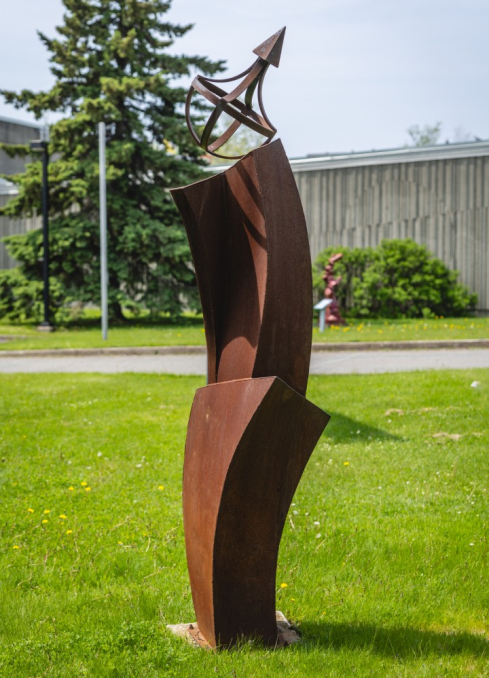 Claude Millette
Corten steel, painted
Collection: Musée du Bas-Saint-Laurent
MRC de Rivière-du-Loup 310, rue Saint-Pierre - Inaugurated in 2002
Born in Saint-Hyacinthe, Claude Millette studied at the École de sculpture de Saint-Jean-Port-Joli from 1975 to 1976, and then apprenticed with sculptors Jordi Bonet (1977) and Robert Poulin (1979). He soon developed a deep interest in metals and committed himself to an artistic approach driven by a constant desire to experiment with materials. He seeks to bring a sense of sensuality to raw, rigid materials, particularly steel.
The sculpture Générescence consists of three stacked volumes with curved lines. Two rectangular shapes, standing one on top of the other, give the impression of fluidity despite their considerable mass. Resting on the second module, a truncated globe tilts toward the ground. Its other side stretches out like an arrow, pointing toward the sky. Together, the three volumes evoke a figure dancing beneath the heavens, anchored firmly to the earth while reaching for the stars.
Movement is central to Millette’s practice, both in the themes he explores and in the execution of his sculptures. By transforming the material, he engages his whole body in the process, channeling a sense of form and expression into the metal. The work takes shape through the artist’s gesture, with his energy forever etched into the heart of the composition.
What stands out most to you in this work: lightness or solidity?
 François Maltais
Steel, aluminium, copper, stainless steel
Collection: MRC de Rivière-du-Loup
MRC de Rivière-du-Loup, 310 rue Saint-Pierre - Inaugurated in 2013
Originally from the Lac‑Saint‑Jean region and now based in Rivière‑du‑Loup, artist François Maltais holds an interdisciplinary Bachelor of Fine Arts degree from the Université du Québec à Chicoutimi. Actively involved in the cultural scene, he taught at the Cégep de Rivière-du-Loup arts department from 1999 to 2023 and served as the artistic director of the intercollegiate snow sculpture competition from 2015 to 2023.
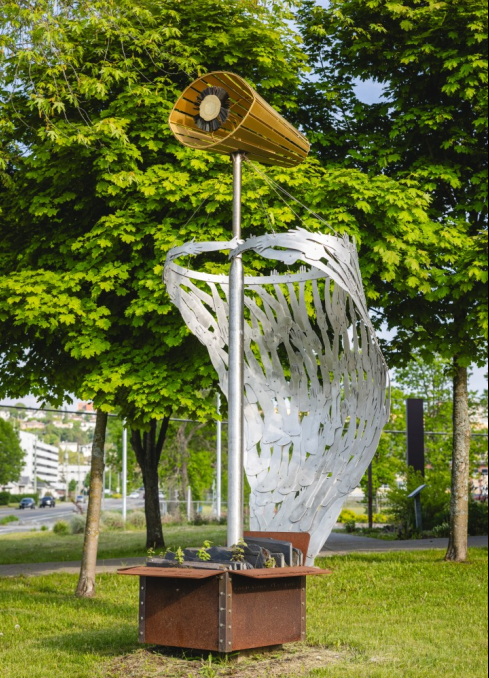
The sculpture Le visionnaire takes the form of an imaginary vessel, at the top of which sits an eye turned towards the horizon. The iris is composed of dozens of copper plaques, each holding the vision of the future of the people of Rivière-du-Loup. Through a creative process involving the community, Maltais invited both children and adults to share their hopes and commitments for the future, which were later engraved on the plaques. Made up of dozens of outstretched arms, the sail incorporates the arms of participants, photographed by the artist and then cut out from aluminum.
Inaugurated in 2013, the work was created to highlight the 2011–2031 strategic vision of the RCM of Rivière-du-Loup, which focuses on positioning the community for the future. A symbol of collective desires, Le visionnaire stays on course toward a future defined by creativity, commitment and innovation.
The words engraved on the base of the sculpture express the hopes and commitments of children and adults for the future. What would yours be?
 David Sorensen
Welded and painted steel
Collection: Musée du Bas-Saint-Laurent
MRC de Rivière-du-Loup, 310 rue Saint-Pierre - Inaugurated in 2002
Born in Vancouver, David Sorensen (1937–2011) studied under architect Arthur Erickson, sculptor Iljuwas Bill Reid and painter Jack Shadbolt before settling in Quebec in the mid-1960s. Drawn to Quebec modern art, Sorensen developed an artistic approach grounded in abstraction and expressiveness. He is especially known for his painting, where he sought to convey the personal impressions left by the places he visited and inhabited.
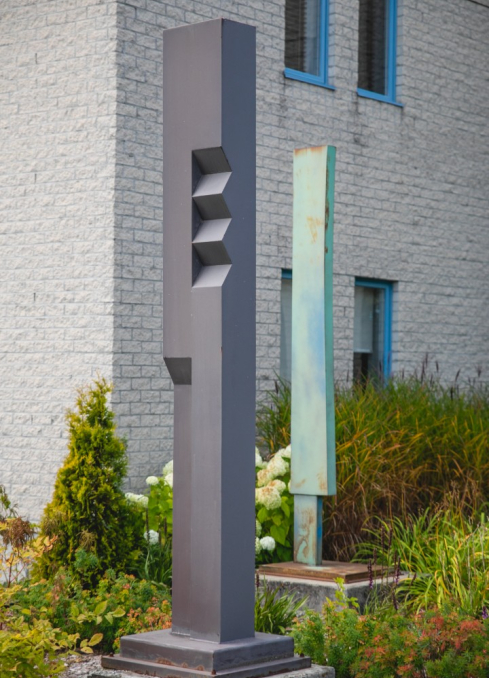
Millenium Stele A (AGX 1) and Millenium Stele B (AGX 2) are two geometric structures made up of vertically standing rectangles. Minimalist and linear in appearance, the narrow, elongated metal forms recall the silhouette of buildings stripped of all ornament. Their colours reference the hues of metal: blue-green evokes oxidized copper, while grey suggests raw steel.
The Millenium Stele sculptures reflect the artist’s interest in architecture and materiality. Despite their industrial appearance, they embody a profound connection to the human mind and human activity. They highlight metal as both material and subject, with its history closely tied to human progress, and point to the human presence behind every architectural and technical endeavour.
What connections do you notice between these sculptures and the nearby building?
 Claude Millette
Steel
Collection: Musée du Bas-Saint-Laurent
Parc du Campus-et-de-la-Cité, coin rue Saint-Pierre et rue Desjardins - Inaugurated in 2010
Born in Saint-Hyacinthe in 1957, Claude Millette studied at the École de sculpture de Saint-Jean-Port-Joli from 1975 to 1976, and then apprenticed with sculptors Jordi Bonet (1977) and Robert Poulin (1979). He soon developed a deep interest in metals and committed himself to an artistic approach driven by a constant desire to experiment with materials. He seeks to bring a sense of vitality to raw, rigid materials, particularly steel.
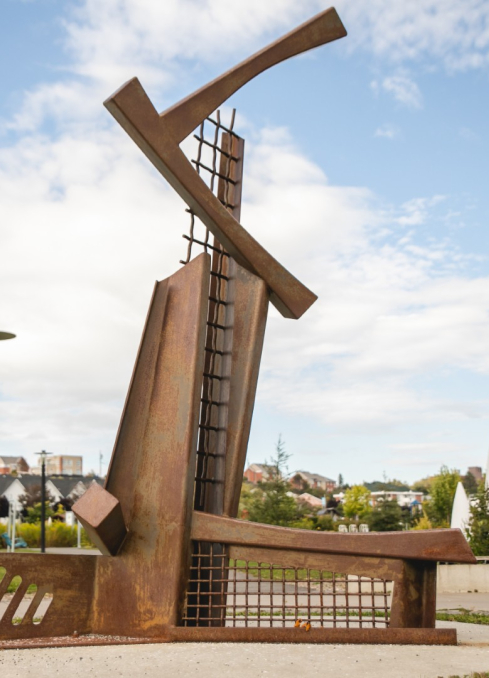
The sculpture Gyrostatique combines the forms and textures of steel in a choreography where flexibility meets rigidity, balance meets instability and stillness meets movement. The interweaving of linear forms, grids and curved lines generates energy within the sculpture. Inspired by dance, where energy arises from tensions between bodies or limbs, Millette creates his works through effects of juxtaposition and opposition.
The title of the sculpture brings together two antithetical ideas: “gyro,” referring to rotational movement, and “static,” which refers to stillness. Similarly, the structure combines solids and voids to sharpen our visual perception. On the very edge of logic, Gyrostatique reflects the artist’s exploration of the idea of confrontation.
Walk around the sculpture and imagine it spinning in the wind.
 Ludovic Boney
Painted aluminum, cedar
Collection: Ville de Rivière-du-Loup
Parc du Campus-et-de-la-Cité - Inaugurated in 2010
Born in Wendake in 1981, Huron-Wendat artist Ludovic Boney studied sculpture at the Maison des métiers d’art de Québec and began working on public art projects early in his career. Known for his large-scale, colourful works, he plays with codes and materials to create contrasting compositions that blend cultural tradition with contemporary form.
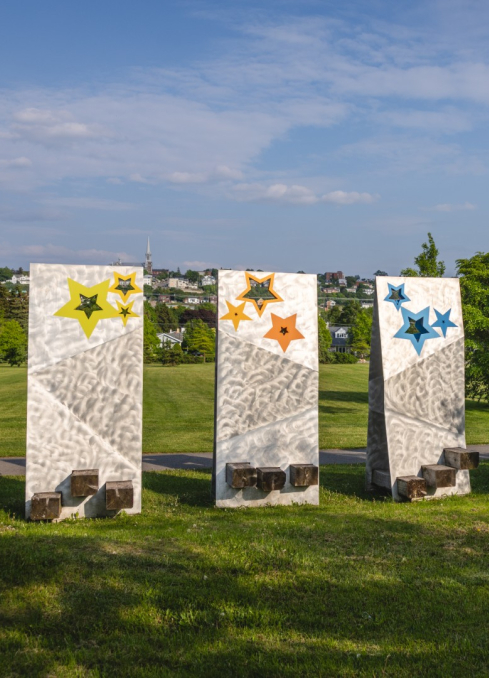
The installation Fleur d’assise consists of five aluminum modules, each perforated with multi-coloured stars and intersected by three cedar beams. Like a line of train carriages unfurling along the path, the work speaks to the historic importance of the railway network in the development of Rivière‑du‑Loup. Arranged in a zigzag pattern, the sturdy wooden beams appear to be set in motion, calling to mind the movement of old locomotive wheels.
At the same time, Fleur d’assise echoes the surrounding natural environment. The folds disrupting the line of the metal evoke the rocky surfaces of nearby outcrops and the smaller waterfalls near the impressive Rivière‑du‑Loup falls. At night, the colourful stars align with the celestial bodies above, symbolizing a constant human presence and our long history of looking to the stars.
Step back to observe the motion created by the folded metal and the placement of the wooden beams.
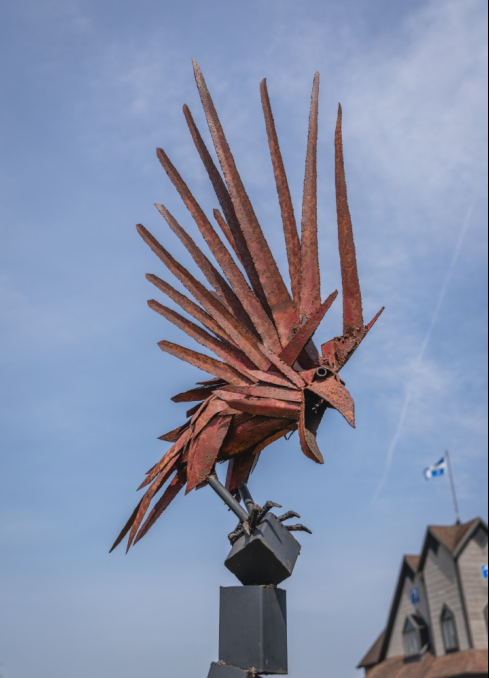 Marcel Braitstein
Painted steel
Collection: Musée du Bas-Saint-Laurent
Bureau d'information touristique de Rivière-du-Loup 189, boul. de l'Hôtel-de-Ville - Inaugurated in 2002
Born in Belgium in 1935, artist and writer Marcel Braitstein immigrated to Canada in 1951. A graduate of the École des beaux-arts de Montréal, he taught in the Department of Visual Arts (now the École des arts visuels et médiatiques) at the Université du Québec à Montréal from 1969 to 1998. Braitstein’s enduring sources of inspiration include the human condition and the natural world, which emerge in his exploration of themes such as death and destruction in both his sculptural and literary work.
Oiseau sur colonne depicts a bird perched atop a fractured column. With wings outstretched, beak agape and claws extended, the bird strikes a menacing pose. Created using welded metal, the sculpture features sharp, jagged elements that, combined with bright red paint, heighten its expressive, unsettling character. The bird’s plumage, typically soft and downy, appears rigid and blade-like, as sharp as a sword.
Part of the artist’s ongoing exploration of animal figures, Oiseau sur colonne reflects Braitstein’s fascination with both real and mythical creatures. Of Jewish heritage, he often draws from this imagery to evoke the horrors of war, which he experienced first-hand during the German occupation of Belgium in World War II.
As you look at the sculpture, what relationship do you see between the bird and the column? What do you think this interaction might represent?
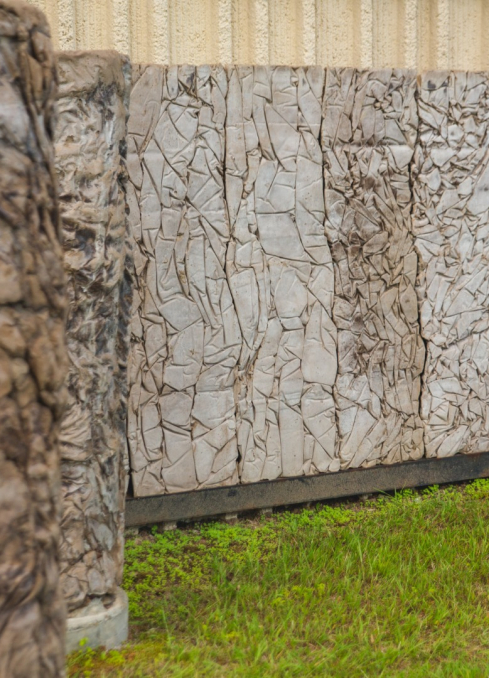 Tatiana Démidoff-Séguin
Vitrified cast cement, steel
Collection: Musée du Bas-Saint-Laurent
118, boul. Hôtel-de-Ville - Inaugurated in 2003
Note: This installation will be installed in the museum gardens during the 2026 summer.
Of Russian and French descent and born in Algeria, artist Tatiana Démidoff-Séguin (1935–2006) moved to Quebec in 1962 after studying art in Paris and Algiers. A co-founder of Espace, a magazine dedicated to contemporary sculpture, she became a key figure in Quebec’s sculptural scene through both her artistic practice and her deep commitment to the field.
Transmutation is a cement installation composed of three columns, each weighing 500 pounds (225 kg), and a bas-relief weighing 6,800 pounds (3,000 kg). Despite its considerable weight, the piece appears deceptively light, as though made from a soft, crumpled material. The polished surfaces, marked by folds and creases, give an impression of pliability that defies the very nature of cement. Démidoff-Séguin thus plays with visual perception, casting doubt on the material reality of the work.
Transmutation was created with a trowel, a tool used in masonry for spreading paste-like materials and in art for applying paint to canvas. This technique blends references to both modern art and the world of construction. Alongside the traces left by the production process, the artist’s hand is clearly present, inviting reflection on the hierarchy of materials, some historically deemed “noble,” others “humble,” and prompting us to question our assumptions.
This work features a variety of textures. Why not take a moment to feel them?

Set out on foot or by bike to discover some 40 works of art installed all around Rivière-du-Loup. This impressive collection brings together pieces by some of the biggest names in Canadian art.
Intervalle is an invitation to pause and awaken your senses during moments of stillness in the urban landscape.
Explore the trail on your own or join one of our guided walking tours, which leaves the Musée every Sunday at 11 a.m.!
$15 + tax. 5$ for kids (Free for children under 5).
(The fee also includes admission to the Musée.)
Guided Tours
The tour includes artworks in the Parc de la Pointe linear riverside park and a snack at the Café culturel de la Pointe. Maximum of four adults per tour, ages 18 and up.
Schedule and prices:
Saturdays 1:30–4:30 p.m. $45 + tax
Click HERE to book the 3-hour tour (via the De la Pointe Park)
Pick up a printed map of the Intervalle itinerary at the Musée du Bas-Saint-Laurent or the Rivière-du-Loup tourist information office.
To learn more, visit the Musée du Bas-Saint-Laurent or visit our website at mbsl.qc.ca.
.png)