Filtrer les résultats
 Armand Vaillancourt
Concrete, steel
Collection: Musée du Bas-Saint-Laurent
Centre Hospitalier du Grand-Portage, côté boul. Armand-Thériault - Inaugurated in 2012
Born in Black Lake, in the Thetford Mines region, Armand Vaillancourt studied at the École des beaux-arts de Montréal in the early 1950s. An artist and committed activist, he has played a significant role in the development of sculpture in Quebec. Although essentially abstract, his works are deeply rooted in social convictions and political advocacy, which he has continuously renewed over nearly seven decades.
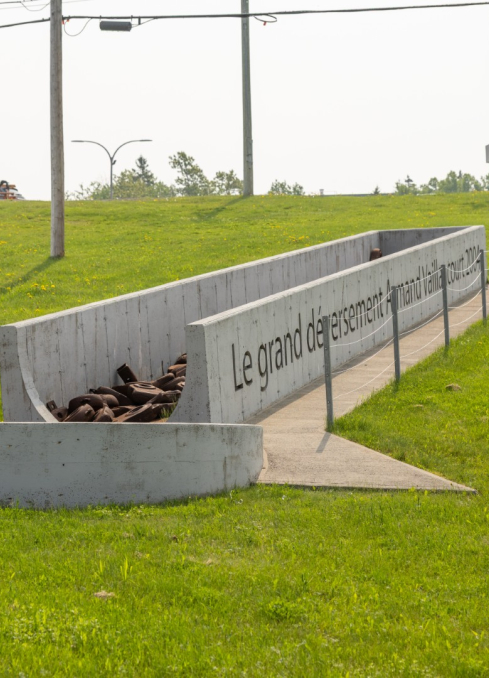
Combining a concrete structure with reclaimed steel components, Le grand déversement takes the form of a culvert filled with rusted objects, its upper section left open. Clearly industrial in appearance, the disordered elements spill into a circular tank reminiscent of a stormwater retention basin. These elements, all identical, are crusher hammers once used to pulverize a wide range of materials for recycling.
The work stands on the site of a former wooden trestle that once connected the Caldwell sawmill to the port and was used to transport lumber to the river. By turning the discarded remnants of our civilization into objects rich with social and historical meaning, Le grand déversement looks back on Rivière-du-Loup’s past while offering a sobering reflection on the planet’s environmental future.
In this sculpture referencing “a great spill,” what other objects could have taken the place of the crusher hammerheads?
 André Fournelle
Welded and painted steel
Collection: Musée du Bas-Saint-Laurent
51, rue Fraserville - Inaugurated in 2004
Born in England in 1939 and raised in Montréal, artist André Fournelle trained in sculpture under Armand Vaillancourt and through workshops in the United States and Europe. In collaboration with sculptor Marc Boisvert, he established an experimental, collective foundry in Pierrefonds in 1967. A war orphan, Fournelle grounds his practice in a deep sensitivity to human fragility and a firm commitment to social and political engagement.
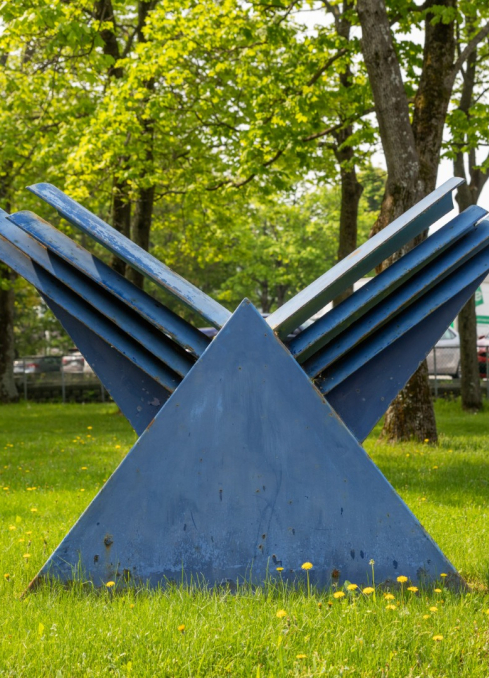
The sculpture Les ailes de la liberté consists of two nearly identical pieces whose shape evokes the instant of take-off. Created in the context of the October Crisis, the work expresses the artist’s support for activists Pierre Vallières and Charles Gagnon, imprisoned during the turbulent events leading up to October 1970. The pieces represent two identities distinguished by their distinct colours but united by their shared form.
In this way, Les ailes de la liberté takes a clear stand in favour of social justice, at a time when many were defending freedom of expression and thought in the face of accusations levelled against their writings. The sculpture thus serves as an act of remembrance, preserving and transmitting an important perspective on Quebec’s history.
This piece is a tribute to two political prisoners from the October Crisis of 1970. How do these sculptures evoke freedom for you?
Set out on foot or by bike to discover some 40 works of art installed all around Rivière-du-Loup. This impressive collection brings together pieces by some of the biggest names in Canadian art.
Intervalle is an invitation to pause and awaken your senses during moments of stillness in the urban landscape.
Explore the trail on your own or join one of our guided walking tours, which leaves the Musée every Sunday at 11 a.m.!
$15 + tax. 5$ for kids (Free for children under 5).
(The fee also includes admission to the Musée.)
Guided Tours
The tour includes artworks in the Parc de la Pointe linear riverside park and a snack at the Café culturel de la Pointe. Maximum of four adults per tour, ages 18 and up.
Schedule and prices:
Saturdays 1:30–4:30 p.m. $45 + tax
Click HERE to book the 3-hour tour (via the De la Pointe Park)
Pick up a printed map of the Intervalle itinerary at the Musée du Bas-Saint-Laurent or the Rivière-du-Loup tourist information office.
To learn more, visit the Musée du Bas-Saint-Laurent or visit our website at mbsl.qc.ca.
.png)