Filtrer les résultats
 André Fournelle
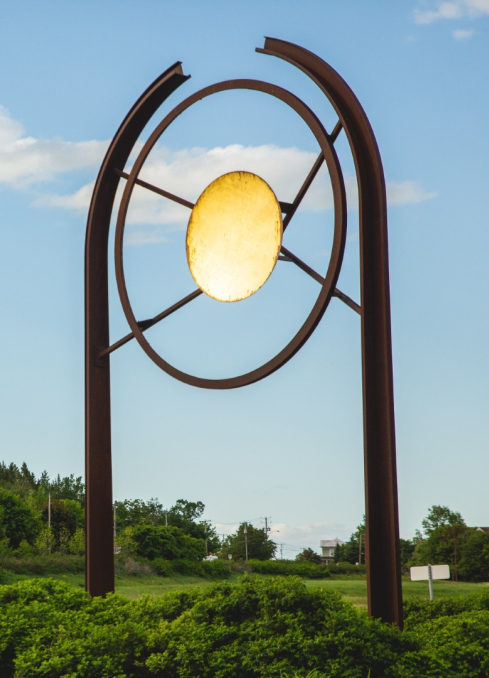
Corten steel, gold leaf, integrated lighting
Collection: Musée du Bas-Saint-Laurent
Carrefour giratoire, entrée ouest de la ville, boul. Hôtel-de-Ville - Inaugurated in 2010
Born in England in 1939 and raised in Montréal, artist André Fournelle trained in sculpture under Armand Vaillancourt and through workshops in the United States and Europe. In collaboration with sculptor Marc Boisvert, he established an experimental, collective foundry in Pierrefonds in 1967. A war orphan, Fournelle grounds his practice in a deep sensitivity to human fragility and a firm commitment to social and political engagement.
L’accueil takes the form of a tall arch, at the centre of which sits a disk covered in gold leaf. Encircled by a large ring, the vertical dome evokes a pupil or a distant planet. By day, it reflects the sun’s rays; by night, it mirrors the light from the ring’s integrated illumination. The work speaks to the artist’s enduring interest in fire and, by extension, all forms of incandescence.
The orange structure and the vivid yellow dome together make the work a striking focal point of the roundabout where it stands. Installed at the city’s western edge since 2009, L’accueil lives up to its name, offering a majestic welcome to all those arriving in Rivière-du-Loup.
Considering where the sculpture is placed, what do the title [“welcome” in English] and form suggest to you?
 Yves Trudeau
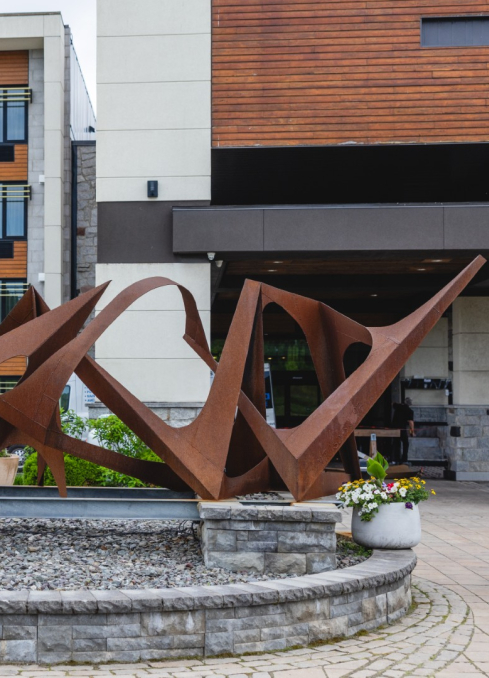
Welded Corten steel
Collection: Musée du Bas-Saint-Laurent
311, boul. Hôtel-de-Ville - Inaugurated in 2010
Born in Montréal in 1930, Yves Trudeau (1930–2017) began studying art as a teenager and launched his sculpting career in the late 1950s. Actively involved in several professional organizations, he was a founding member of the Association des sculpteurs du Québec, playing a key role in the creation of the Musée d’art contemporain de Montréal.
The untitled sculpture, dubbed Enchevêtrement (or “entanglement”) is made from shapes cut out of steel sheets and then welded together. The resulting tangle appears to bear the marks of folding, as though the artist had bent the metal back onto itself, like a sheet of paper, to open up certain sections. Because of its intricacy, it is difficult to determine where the structure begins or ends, with its many elements interlaced in a complex web.
Driven by a fascination with movement, momentum and gravity, Trudeau created works that, rather than anchoring themselves to the ground, seem to lift skyward. Untitled (Enchevêtrement) is part of the artist’s ongoing exploration of mobility in sculpture. The piece’s numerous folds and creases, along with its many openings, give it a sense of lightness and fluidity, further enhancing its paper-like quality.
Born in Montréal in 1930, Yves Trudeau (1930–2017) began studying art as a teenager and launched his sculpting career in the late 1950s. Actively involved in several professional organizations, he was a founding member of the Association des sculpteurs du Québec, playing a key role in the creation of the Musée d’art contemporain de Montréal.
The untitled sculpture, dubbed Enchevêtrement (or “entanglement”) is made from shapes cut out of steel sheets and then welded together. The resulting tangle appears to bear the marks of folding, as though the artist had bent the metal back onto itself, like a sheet of paper, to open up certain sections. Because of its intricacy, it is difficult to determine where the structure begins or ends, with its many elements interlaced in a complex web.
Driven by a fascination with movement, momentum and gravity, Trudeau created works that, rather than anchoring themselves to the ground, seem to lift skyward. Untitled (Enchevêtrement) is part of the artist’s ongoing exploration of mobility in sculpture. The piece’s numerous folds and creases, along with its many openings, give it a sense of lightness and fluidity, further enhancing its paper-like quality.
 Bill Vazan
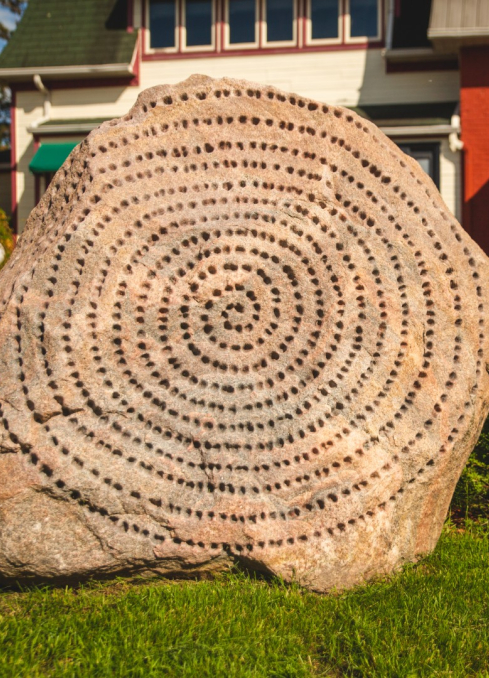
Sandblasted granite
Collection: Musée du Bas-Saint-Laurent
169, rue Fraser - Inaugurated in 2002
Born in Toronto in 1933, Bill Vazan studied at the Ontario College of Art and Design, the Beaux-Arts de Paris school and Sir George Williams University in Montréal, where he settled in 1957. Motivated by the desire to bring Montréal and Quebec into an international network, he was instrumental in founding Véhicule Art (Montréal) Inc., a major artist-run centre that showcased contemporary and experimental practices during the 1970s.
Rooted in the belief that nature and humanity are deeply interconnected, his artistic process draws inspiration from land art—an art movement that began in the 1960s focusing on creating artworks directly in and with the landscape. Throughout his career, Vazan has created an extensive body of carved stone works bearing symbolic motifs. These engravings often reference the marks left by human presence on the land.
The sculptures Dense and Vapour both feature winding patterns unfolding in multiple spirals and labyrinthine forms. These motifs suggest the serpentine path of a living being or its fossilized remains, while also echoing human movement, carving its way across the land and even into earth’s crust, the deepest substratum.
Which elements of nature does the movement in Vazan’s works evoke for you?
 Dominique Rolland et Dominique Valade
Corten steel, titanium, cast aluminum lamppost, wrought iron fences, steel
Collection: Musée du Bas-Saint-Laurent
108, rue Fraser - Inaugurated in 2015
Dominique Rolland studied sculpture at the Université du Québec à Montréal from 1974 to 1979, before founding in 1983 the Centre des arts contemporains, a Montréal space dedicated to the diffusion and creation of monumental sculpture. His artistic practice is based on his strong interest in history. Dominique Valade holds a Master of Fine Arts degree (1994) and a PhD in Arts Studies and Practices (2004) from the Université du Québec à Montréal, where she focused on the reinterpretation of landscapes in sculptural work.
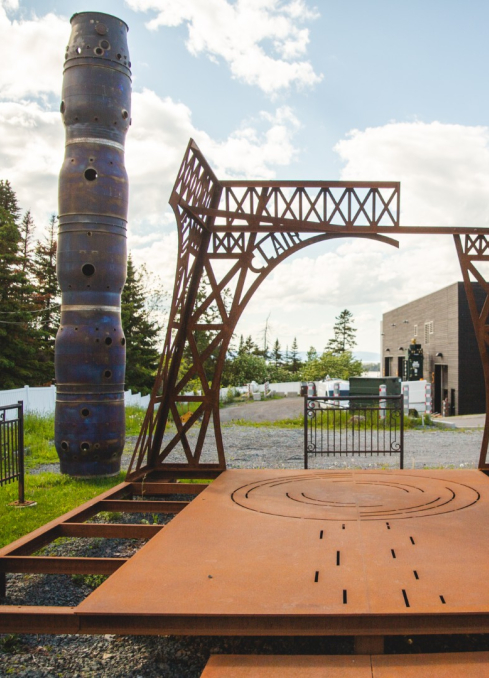
The installation Clair de lune takes the form of a whimsical agora inspired by the public squares of Ancient Greece—the heart of the city’s economic and political life. It consists of a platform framed by metal arches, reminiscent of the iconic Eiffel Tower, and two columns, with rounded edges and multiple portholes that evoke the submarines imagined by writer Jules Verne.
Wrought iron fences border the eclectic structure, where a hidden lighting system is visible through openings in the tallest column. Like something out of a science-fiction novel, Clair de lune merges the past and future, inviting the public to step into the scene and let their imaginations run wild.
This installation might remind you of a stage set. What scenes could unfold here? Who might the characters be
 Tatiana Démidoff-Séguin
Vitrified cast cement
Collection: Musée du Bas-Saint-Laurent
Parc de la Pointe, rue Mackay - Inaugurated in 2003
Of Russian and French descent and born in Algeria, artist Tatiana Démidoff-Séguin (1935–2006) moved to Quebec in 1962 after studying art in Paris and Algiers. A co-founder of Espace, a magazine dedicated to contemporary sculpture, she became a key figure in Quebec’s sculpture scene through both her artistic practice and her deep commitment to the field.
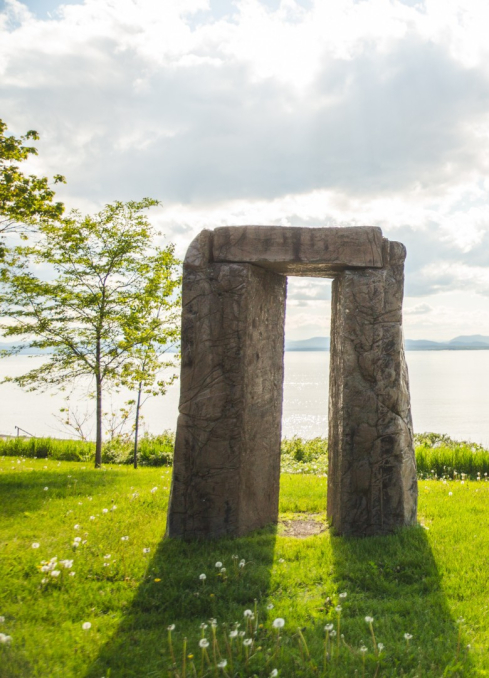
Composed of two pillars topped with a lintel, Passage calls to mind the iconic stone structures of Stonehenge. Its surface bears the imprint of the moulding process, yet the glossy sheen achieved through vitrification—where cement is transformed into a glass-like material through melting and cooling—adds a refined, almost polished quality. The interplay between these contrasting techniques invites reflection on materiality and its impact on the human experience.
As the title suggests, the sculpture is meant to be walked through. It functions as a kind of portal to a distant past beyond the reach of memory, opening onto the river and echoing its timeless fusion of sand and water. Straddling the line between historical tableau and architectural object, Passage balances strength and fragility, all while evoking the passing of time and the traces it leaves behind.
This passage is meant to be walked through. What does it lead you to?
 Michel Bernier et Myriam Kachour
Steel
Collection: Musée du Bas-Saint-Laurent
Parc de la Pointe, rue Mackay - Inaugurated in 2010
Artists Michel Bernier and Myriam Kachour share a deep appreciation for materials and the world around them. An ironworker, welder and sculptor, Bernier specializes in metalwork and makes large-scale sculptures for a number of artists. Kachour, meanwhile, creates visual art projects that often take the form of immersive installations. The artists have produced numerous works together.
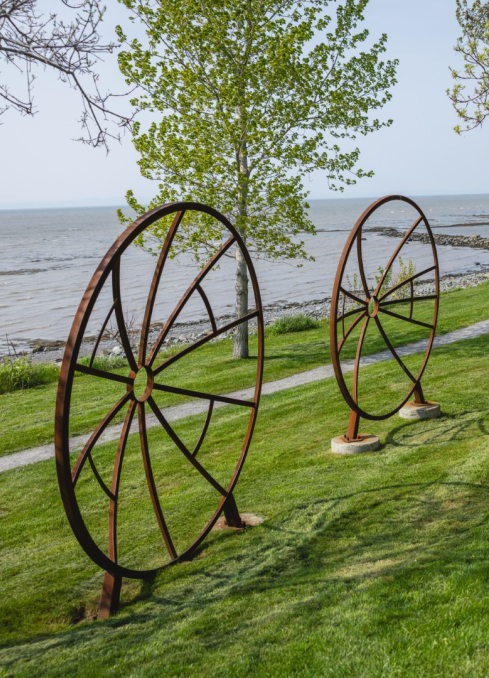
Nature et protection consists of four rounded structures evoking various symbols, including a shield, windmill blades, a compass and a sundial. These steel forms divide the landscape into segments like a pie chart, their rigidity contrasting with the fleeting quality of the maritime backdrop. Erected in front of the river, the metal armatures impassively frame the shifting scenery, offering a range of viewpoints that invite new ways of seeing the world.
Intersected by the natural elements, the sculpture captures the energy of the sea winds and the cyclical whisper of the tides. Its anchored, silent presence invites contemplation, an escape from the clamour of daily life, to focus on the here and now in the presence of the river’s beauty. The sculpture becomes a quiet mediator between the self and the vastness beyond, forging a subtle connection between humanity and nature.
Each structure offers a unique view of the landscape. Try walking around and seeing them from different angles. Which one is your favourite?
Set out on foot or by bike to discover some 40 works of art installed all around Rivière-du-Loup. This impressive collection brings together pieces by some of the biggest names in Canadian art.
Intervalle is an invitation to pause and awaken your senses during moments of stillness in the urban landscape.
Explore the trail on your own or join one of our guided walking tours, which leaves the Musée every Sunday at 11 a.m.!
$15 + tax. 5$ for kids (Free for children under 5).
(The fee also includes admission to the Musée.)
Guided Tours
The tour includes artworks in the Parc de la Pointe linear riverside park and a snack at the Café culturel de la Pointe. Maximum of four adults per tour, ages 18 and up.
Schedule and prices:
Saturdays 1:30–4:30 p.m. $45 + tax
Click HERE to book the 3-hour tour (via the De la Pointe Park)
Pick up a printed map of the Intervalle itinerary at the Musée du Bas-Saint-Laurent or the Rivière-du-Loup tourist information office.
To learn more, visit the Musée du Bas-Saint-Laurent or visit our website at mbsl.qc.ca.
.png)