Filtrer les résultats
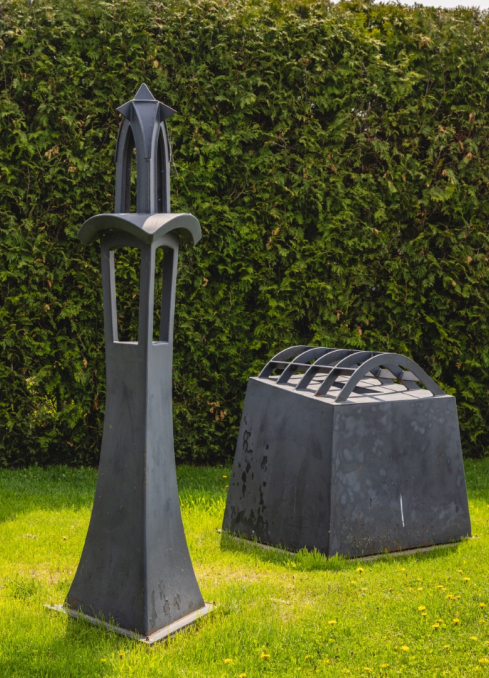
 Claude Millette
Painted steel
Collection: Musée du Bas-Saint-Laurent
Parc de la Croix, rue Sainte-Claire - Inaugurated in 2006
Born in Saint-Hyacinthe in 1957, Claude Millette studied at the École de sculpture de Saint-Jean-Port-Joli from 1975 to 1976, and then apprenticed with sculptors Jordi Bonet (1977) and Robert Poulin (1979). He soon developed a deep interest in metals and committed himself to an artistic approach driven by a constant desire to experiment with materials. He seeks to bring a sense of vitality to raw, rigid materials, particularly steel.
The Les cages de l’âme sculpture series comprises three works that each explore the theme of captivity in their own way. Painted black to emphasize the precision of their lines, the sculptures have a dual nature: they both confine and protect. In contrast to the sense of enclosure they evoke, their rounded forms rise skyward, as if gradually shedding their weight.
Les cages de l’âme 1, 2, and 3 are composed of arches and pointed forms that come together to create skeletal vaults and arcades. In referencing architecture, the sculptures speak to one another through the lightness of their framework and the solidity of their base. Their suggestive forms invite us to tap into our imagination, like gazing at clouds and discerning familiar shapes.
What might each of these cages contain?
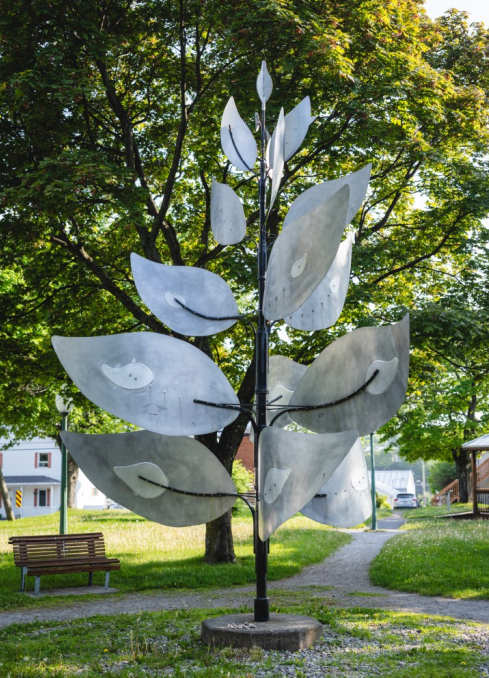 André Brassard
Brushed and polished steel and aluminum
Collection: Ville de Rivière-du-Loup
Parc Vézina, rue Vézina - Inaugurated in 2010
Born in Montréal in 1948, André Brassard studied visual arts at Université Laval in Québec City before beginning a teaching career at the Cégep de Rivière‑du‑Loup. While primarily focused on sculpture, his artistic practice reveals a strong affinity with ecological principles. Brassard is particularly interested in the forces of nature, living beings and movement.
The sculpture Arbor takes the form of a stylized tree bearing large metal leaves. Its title, referring to the Latin word for “tree,” serves as the root for many words. For example, “arborescence” is used to describe something that resembles a tree, which seems especially fitting for Brassard’s work. Arbor reflects the artist’s interest in modular structures and the effects of geometry.
Much like a mobile, the sculpture initially came to life with the movement of air. Then, after its leaves were immobilized, it is the viewer’s imagination that lends it a flowing presence and makes its leaves tremble. It appears, in a sense, to possess a life and history of its own, just like the majestic trees that surround it. Blending art and nature, Arbor is nestled within a leafy setting that weaves together cultural vitality, botanical harmony and the enduring resilience of the living world.
What does the tree symbolize to you, and how is that meaning reflected in this artwork?
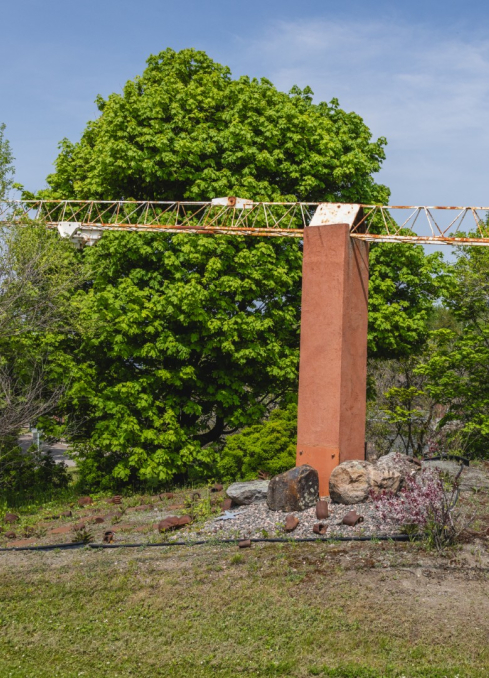 Tony Brown
Granite, steel, cast iron, aluminum, soil, plants
Collection: Musée du Bas-Saint-Laurent
En face du 147, rue Amyot - Inaugurated in 2003
Born in England in 1952, Canadian artist Tony Brown studied at the University of Manitoba in Winnipeg (1971–1975), the Nova Scotia College of Art and Design in Halifax (1975–1976), and Concordia University in Montréal (1977–1978). He later lived in France, where he taught at the École nationale supérieure des beaux-arts in Paris, and then in China, where he held a teaching post at Xi’an Eurasia University. Since the 1980s, Brown has created works that explore the impact of technology on human experience.
Through the Motions between the Stars takes the form of a crane, its horizontal arm extending over what resembles an archaeological dig. Fragments of statues, eerily reminiscent of ancient Greek sculpture, lie alongside large metal plates arranged like a chessboard. At the top of the crane, a star hangs suspended, imbuing the scene with a cosmic dimension. Remnants of a vanished civilization and traces of an industrial present lie quietly beneath the starry sky.
Together, these elements conjure the ruins of an imagined society. Through the Motions between the Stars reflects on the trials faced by humanity throughout history, and in particular, on the ways in which technology, initially designed to help us overcome hardship, can go awry.
Looking at the fragments on the ground, can you imagine what the statues might have looked like before they became ruins?
 André Fournelle
Granite, steel, wrought iron
Collection: Musée du Bas-Saint-Laurent
Parc des Chutes, rue Amyot - Inaugurated in 2003
Born in England in 1939 and raised in Montréal, artist André Fournelle trained in sculpture under Armand Vaillancourt and through workshops in the United States and Europe. In collaboration with sculptor Marc Boisvert, he established an experimental, collective foundry in Pierrefonds in 1967. A war orphan, Fournelle grounds his practice in a deep sensitivity to human fragility and a firm commitment to social and political engagement.
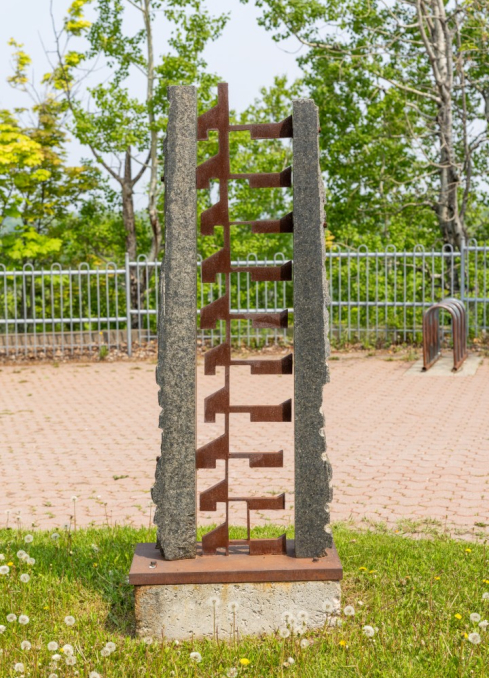
The sculpture Scala—Italian for “ladder”—consists of two granite columns. Bearing the marks of extraction, they flank a metal structure with irregular forms. The green granite of the columns and the steel of the structure contrast in both weight and colour, while each evokes a connection to nature. This dialogue between materials reflects the artist’s fascination with materials and his relationship with the environment.
Following a stay in Italy in the late 1970s, during which he conducted research in art foundries, Fournelle began using Italian titles for some of his works. Scala is part of a series of sculptures centred on the motif of the column. Throughout the 1980s, the artist explored numerous variations on this architectural form, which recalls the technical and cultural achievements of Greco-Roman civilization.
What comes to mind when you consider the use of green granite and steel in Scala (Italian for “ladder”)?
 Gaétan Blanchet
Wood, metal, steel cables, motor
Collection: Musée du Bas-Saint-Laurent
Parc des Chutes, rue de la Chute - Inaugurated in 2003
After studying at the École des beaux-arts de Québec, artist Gaétan Blanchet taught at the École des métiers de Rivière-du-Loup from 1967 to 1969, and then at the Cégep de Rivière-du-Loup from 1969 to 1996. An active member of the Bas-Saint-Laurent artist collective Au bout de la 20 until its dissolution in 1998, Blanchet marked the landscape of the region with his nature-inspired mobile sculptures.
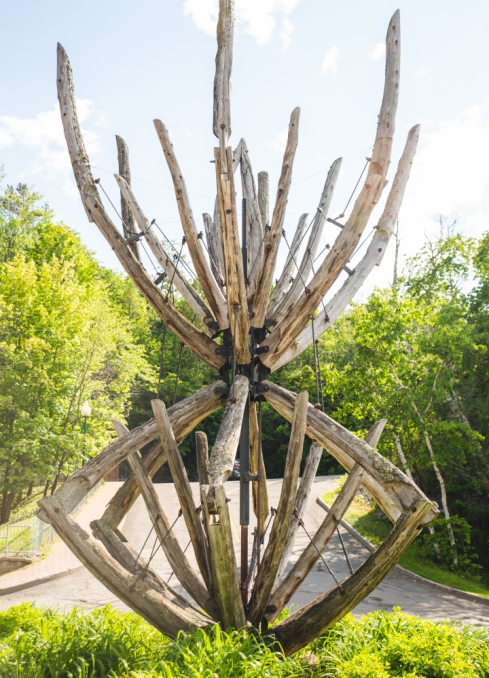
Solstice is made up of 39 peeled cedar trunks, linked together by a system of steel cables and arranged to evoke the corolla of a flower. Originally, an electric mechanism allowed the sculpture to open and close. Through this cyclical movement, it echoed the intervals of time between the sunrise and sunset of the summer solstice (the longest day) and the winter solstice (the shortest day).
At Parc des Chutes, Blanchet’s work interacts powerfully with the history of the site, which was home to large sawmills. Solstice fuses the mechanical and the organic, inspired by the natural world’s underlying geometry. It highlights the balance of life and the power of nature, while also celebrating human intervention.
The sculpture originally included a mechanism that set it in motion. Step closer… Can you imagine how it might have moved?
 Robert Roussil
Wood
Collection: Musée du Bas-Saint-Laurent
Parc des Chutes, entrée rue Frontenac de l’autre côté de la passerelle - Inaugurated in 2013
Born in east-end Montréal and later settling in Tourrettes-sur-Loup, France, where he lived from 1956 until his death, artist Robert Roussil (1925–2013) played a key role in the early development of modern sculpture in Quebec. Bold and avant-garde, Roussil consistently challenged the status quo and was a driving force behind Quebec’s artistic liberation, though not without stirring up some controversy along the way. His sculptural practice was grounded in a deep affinity for public space and a visceral love of nature.
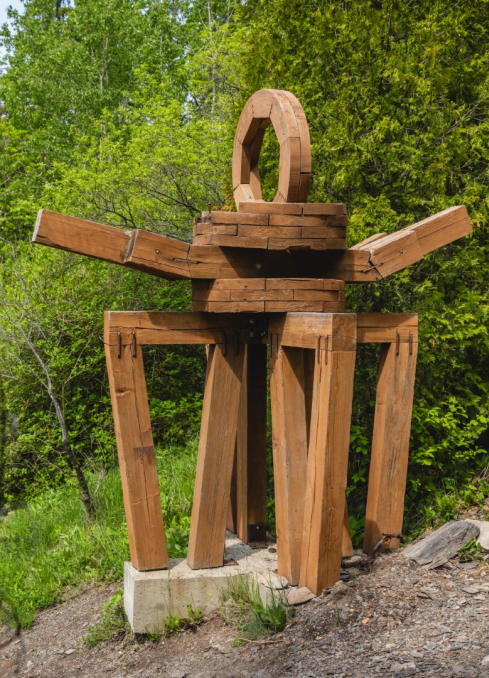
This series of three sculptures embodies the major themes at the heart of his work: germination, blossoming, growth and energy. Part of a broader body of wooden sculptures built around overlapping circular forms, the works evoke the natural world as articulated, part-animal, part-plant creatures.
Carved from western yellow pine—a tree whose deep root system and towering crown mirror Roussil’s own concerns—the sculptures reach joyfully toward the sun while remaining firmly rooted in the earth. The trio punctuates the landscape with a rhythmic presence, reflecting the artist’s ingenuity and sparking a sense of wonder at nature’s raw vitality.
What kind of dialogue is created between these sculptures and their surroundings?
Set out on foot or by bike to discover some 40 works of art installed all around Rivière-du-Loup. This impressive collection brings together pieces by some of the biggest names in Canadian art.
Intervalle is an invitation to pause and awaken your senses during moments of stillness in the urban landscape.
Explore the trail on your own or join one of our guided walking tours, which leaves the Musée every Sunday at 11 a.m.!
$15 + tax. 5$ for kids (Free for children under 5).
(The fee also includes admission to the Musée.)
Guided Tours
The tour includes artworks in the Parc de la Pointe linear riverside park and a snack at the Café culturel de la Pointe. Maximum of four adults per tour, ages 18 and up.
Schedule and prices:
Saturdays 1:30–4:30 p.m. $45 + tax
Click HERE to book the 3-hour tour (via the De la Pointe Park)
Pick up a printed map of the Intervalle itinerary at the Musée du Bas-Saint-Laurent or the Rivière-du-Loup tourist information office.
To learn more, visit the Musée du Bas-Saint-Laurent or visit our website at mbsl.qc.ca.
.png)