
Filtrer les résultats
 Pierre Leblanc
Painted steel, stone
Collection: Musée du Bas-Saint-Laurent
Parc Blais, coin rue Lafontaine et rue du Rocher - Inaugurated in 2002
Born in the Côte‑Saint‑Paul neighbourhood of Montréal in 1949, Pierre Leblanc learned the fundamentals of sculpture under the guidance of artist André Fournelle. His birthplace, shaped by working-class life, and the transformational shifts in the urban and social landscape continue to influence his artistic practice. In his work, he delves into his own past as well as our collective history. Themes of memory and the relationship with architecture are central to many of the sculptor’s projects.
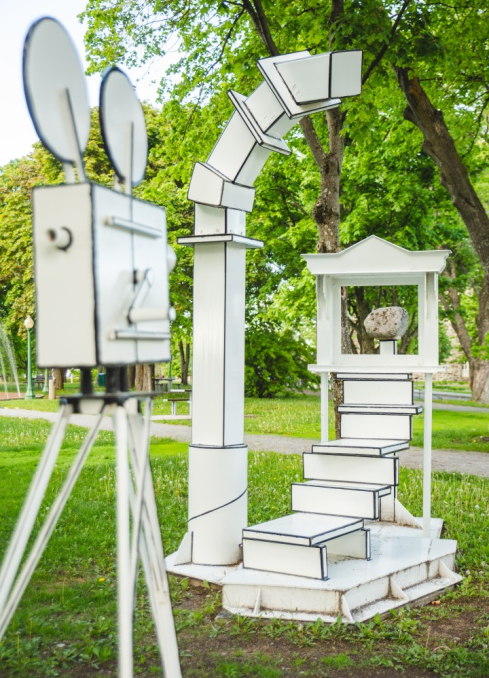
The installation Mémoire consists of two structures assembled like a stage set, made from geometric forms. The first resembles an old hand-crank film camera and stands in front of the second, which evokes a film set. An arched column rises above an asymmetrical staircase, at the top of which rests a window. Framed within the opening, a round stone placed on a small column forms the focal point of the piece.
The stone’s organic, tactile presence stands in stark contrast to the white geometric structures, whose black edges highlight their artificial, constructed appearance. By drawing attention to the stone’s materiality and natural form, Leblanc reveals his reasoning: the focus on the organic world expresses a critical view of consumer society and its impact on the environment.
Why do you think a stone was used as the centrepiece of this work?
 Tatiana Démidoff-Séguin
Vitrified cast cement, steel cable, cement
Collection: Musée du Bas-Saint-Laurent
Devant le Théâtre de la Goélette 67, rue du Rocher - Inaugurated in 2004
Of Russian and French descent and born in Algeria, artist Tatiana Démidoff-Séguin (1935–2006) moved to Quebec in 1962 after studying art in Paris and Algiers. A co-founder of Espace, a magazine dedicated to contemporary sculpture, she became a key figure in Quebec’s sculpture scene through both her artistic practice and her deep commitment to the field.
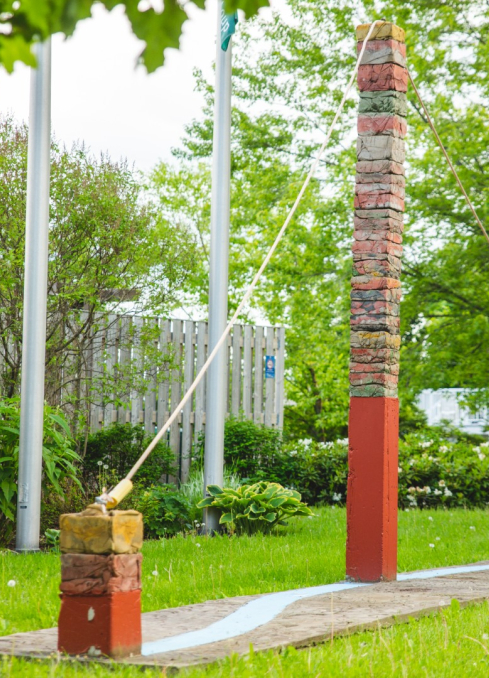
The sculpture Chan Jòdla—named after a Creole phrase meaning “Today is my lucky day”—is part of a series created in Guadeloupe and inspired by the Caribbean archipelago’s environment. It takes the stylized form of a boat, representing its three iconic parts: the bow, mast and stern. Each is made from coloured cement components stacked on a reddish base and connected by a steel cable to suggest the outline of a vessel.
When the sculpture was unveiled in 2008, the artist invited people to leave their mark in the cement base that supports the poles, as she had done in earlier works. This participatory gesture reflects a core aspect of her practice: a collective dimension that not only becomes visible in the work but also helps shape its very foundation.
If the sculpture represents a boat, what story might its title, which translates to “Today is my lucky day,” be telling you?
 Marie-Fauve Bélanger
Granite, painted aluminum
Collection: Ville de Rivière-du-Loup
Bibliothèque Françoise-Bédard, entrée côté ouest 67, rue du Rocher - Inaugurated in 2023
Originally from Lac‑Saint‑Charles, Marie‑Fauve Bélanger holds a Bachelor of Fine Arts and Media Arts degree from Université Laval and a diploma from the Maison des métiers d’art de Québec. Rooted in a practice informed by environmental experience, her work resembles organic and geological fragments where nature and culture intertwine.
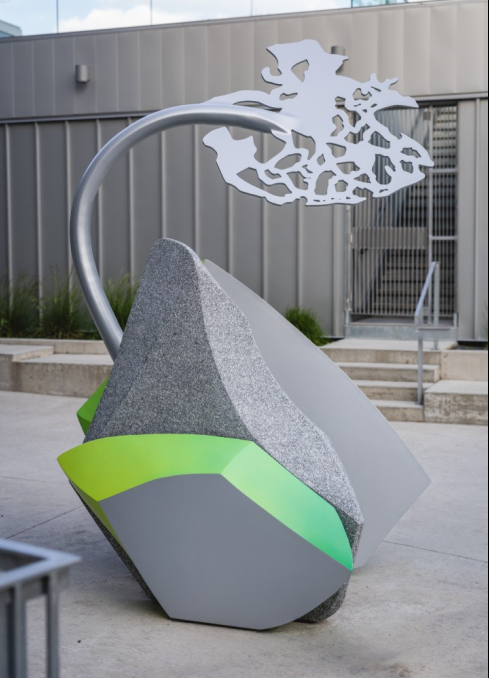
The sculpture Semence is composed of an assemblage of vertical layers, at the centre of which rises a curved stem topped with an openwork leaf. As its title suggests, the piece represents a seed in the process of germinating. Delicately shedding its outer shell to make way for its first shoot, the seed anchors itself in the earth even as it reaches up towards the sun. The juxtaposition of natural and manufactured materials, enriched by varied textures and colours, mirrors the surrounding environment.
From a tiny seed, a towering tree can grow. With the potential to give rise to an entire plant, the seed symbolizes the origins of life and the birth of ideas. Semence brings to mind all the magnificent trees that populate our world, silent witnesses to our lives. It encourages us to reflect on the significance of the things around us, even the most delicate sprout.
What connection do you see between this artwork and reading?
 Dominique Valade
Copper wire, steel, stone, plants
Collection: Musée du Bas-Saint-Laurent
Jardins du Manoir Fraser 32, rue Fraser - Inaugurated in 2004
Dominique Valade holds a Master of Fine Arts degree (1994) and a PhD in Arts Studies and Practices (2004) from the Université du Québec à Montréal, where she focused on the reinterpretation of landscapes in sculptural work. In the 1990s and 2000s, she created a series of installations on the notion of the dwelling, exploring a wide array of elements that surround or form the human habitat.
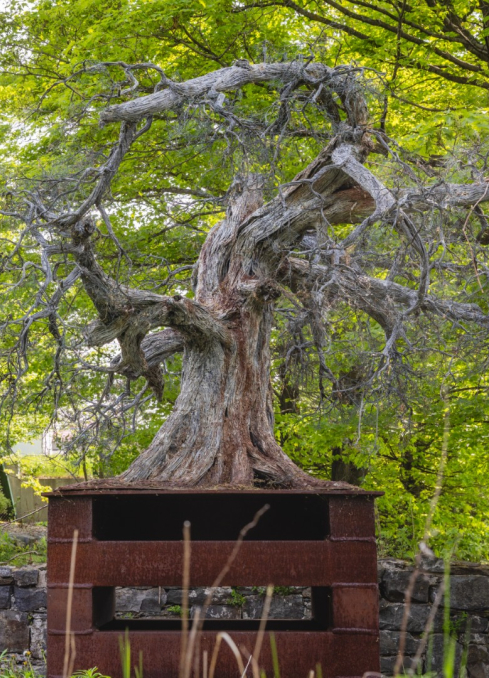
The installation De la cime aux racines : la nature comme abri features two complementary assemblages. On one side, an old apple tree made from copper wire rests on an overturned metal crate. Surrounded by plants, it is enclosed by four ancient stone walls, likely remnants of the Fraser Manor stable. On the other side, a structure crowned with a telescope shelters a tree whose foliage inversely covers its frame.
In dialogue with the historical remnants and vegetation of the site, the piece blends natural and artificial elements to evoke the theme of habitat and the role nature plays in it. De la cime aux racines : la nature comme abri blurs the boundaries between the built and natural environments, highlighting the reciprocal relationships that transform a space into a place of life.
Considering the title [from the crown to the roots, nature is shelter] and the two parts of the work, what links do you see between the tree and shelter?

Set out on foot or by bike to discover some 40 works of art installed all around Rivière-du-Loup. This impressive collection brings together pieces by some of the biggest names in Canadian art.
Intervalle is an invitation to pause and awaken your senses during moments of stillness in the urban landscape.
Explore the trail on your own or join one of our guided walking tours, which leaves the Musée every Sunday at 11 a.m.!
$15 + tax. 5$ for kids (Free for children under 5).
(The fee also includes admission to the Musée.)
Guided Tours
The tour includes artworks in the Parc de la Pointe linear riverside park and a snack at the Café culturel de la Pointe. Maximum of four adults per tour, ages 18 and up.
Schedule and prices:
Saturdays 1:30–4:30 p.m. $45 + tax
Click HERE to book the 3-hour tour (via the De la Pointe Park)
Pick up a printed map of the Intervalle itinerary at the Musée du Bas-Saint-Laurent or the Rivière-du-Loup tourist information office.
To learn more, visit the Musée du Bas-Saint-Laurent or visit our website at mbsl.qc.ca.
.png)