Filtrer les résultats
 Henry Saxe
Welded steel
Collection: Musée du Bas-Saint-Laurent
Jardins du Musée - Inaugurated in 2001
Born in Montréal in 1937, sculptor Henry Saxe attended Sir George Williams University from 1955 to 1956, before enrolling at the École des beaux-arts de Montréal, where he studied from 1956 to 1961. In 1973, he moved to Tamworth, Ontario, where he built a studio that allowed him to experiment with new tools and explore the creation of complex structures.
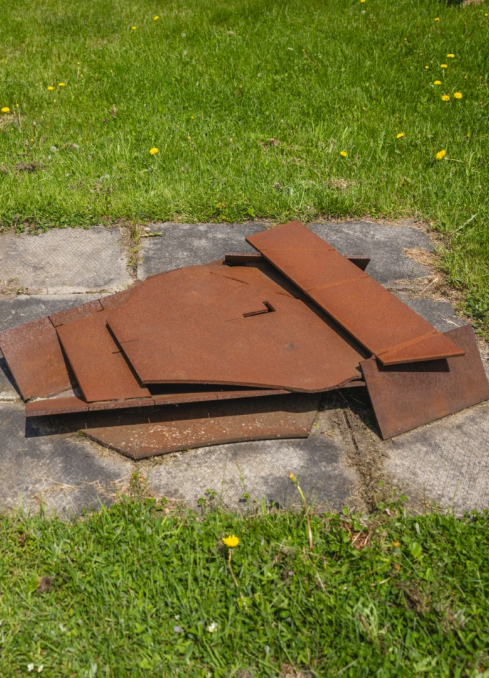
Model of a Distant Model reflects the artist’s ongoing exploration of accumulation and horizontality, recurring themes in many of his public artworks from the late 1970s. Stretching low across the ground, the piece is composed of multiple elements arranged in a way that resembles a scale model. It channels Saxe’s childhood fascination with machines, airplanes, engines and other mechanical inventions.
With its stacked steel plates layered one atop another, the sculpture simultaneously asserts the physical weight of the material and disrupts the viewer’s perception of three-dimensional space. It prompts us to consider how it was constructed, sparking the imagination and inviting us to mentally complete this mysterious form ourselves.
Focus on the folds and openings in this piece. Imagine it assembled in a different way.
 Robert Roussil
Wood
Collection: Musée du Bas-Saint-Laurent
Jardins du Musée - Inaugurated in 2003
Born in east-end Montréal and later settling in Tourrettes-sur-Loup, France, where he lived from 1956 until his death, artist Robert Roussil (1925–2013) played a key role in the early development of modern sculpture in Quebec. Bold and avant-garde, Roussil consistently challenged the status quo and was a driving force behind Quebec’s artistic liberation, though not without stirring up some controversy along the way. His sculptural practice was grounded in a deep affinity for public space and a visceral love of nature.
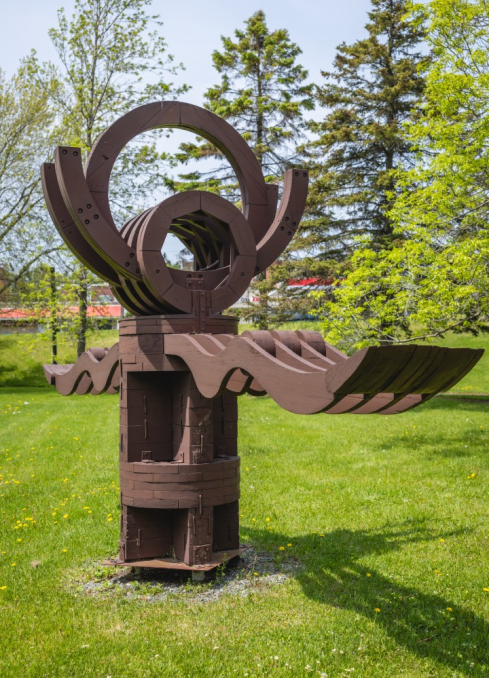
Totem ailé reflects the artistic direction Roussil pursued in the 1980s, a period largely focused on experimenting with wood through the creation of modular sculptures. Centred on a stacked ring column, these bold, rounded forms feature offshoots—horns, mandibles, beaks, branches—that playfully conjure both animal and plant life.
The work calls to mind a bird or flying insect. A trunk-like base supports a head-like shape made of circles and half-circles, from which two side elements extend. These wing-like curves ripple outward, as if stirring the air around them. They give the sculpture a striking presence that exudes the raw energy of nature.
What animals or plants does Totem ailé bring to mind?
 Robert Poulin
Painted steel
Collection: Musée du Bas-Saint-Laurent
Jardins du Musée - Inaugurated in 2000
Active as a professional sculptor from 1972 to 1989, Robert Poulin honed his expertise in steelwork in Japan (1974–1975) and then in a factory in Sorel-Tracy (1976–1979), known as “the steel city” from the 1960s to the 1990s. From that point on, he produced numerous slender sculptures made of curved steel rods. After his sculpting career, he went on to specialize as a gallerist and art collector in the visual arts scene.
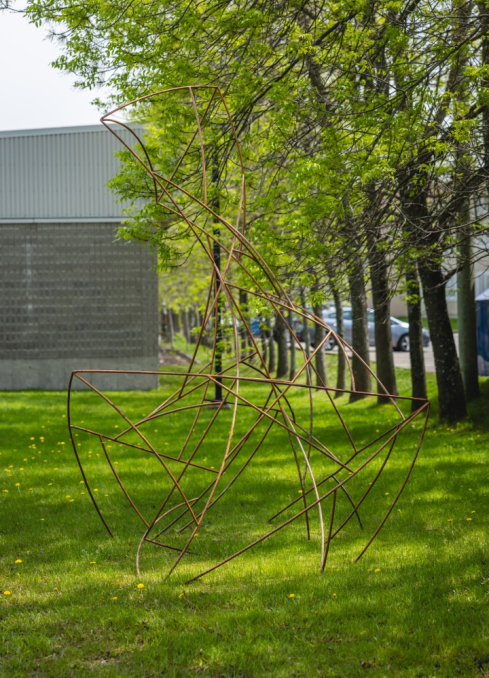
One of Poulin’s first large-scale works, Sans titre already hints at the airy, linear style that would define his later practice. Painted in red, this arrangement of curved steel pipes is reminiscent of a children’s climbing frame. Its colour and playful configuration lend it a fun, spontaneous feel, like a sketch quickly scribbled on paper.
Despite its pared-down form and minimalist use of materials, Sans titre fills its surroundings with vibrant energy. The sculpture draws on geometric simplicity to create an experience shaped by the strength and harmony of its lines. With Poulin’s surprising bends and twists, the work infuses the space with striking expressiveness, a sudden burst of creativity springing up into the space.
If you were to give this sculpture a title, what would it be?
 Guerino Ruba
Cement, steel, fibreglass
Collection: Musée du Bas-Saint-Laurent
Jardins du Musée - Inaugurated in 2001
Born in Pola, Italy (now Pula, Croatia), Guerino Ruba moved to Montréal in 1967, where he studied sculpture at the Université du Québec à Montréal. He went on to teach in the Fine Arts Department at Cégep du Vieux Montréal until 2004. A committed and uncompromising artist, Ruba creates powerful works that confront the darker side of humanity. War, cruelty and death are recurring themes in his work.
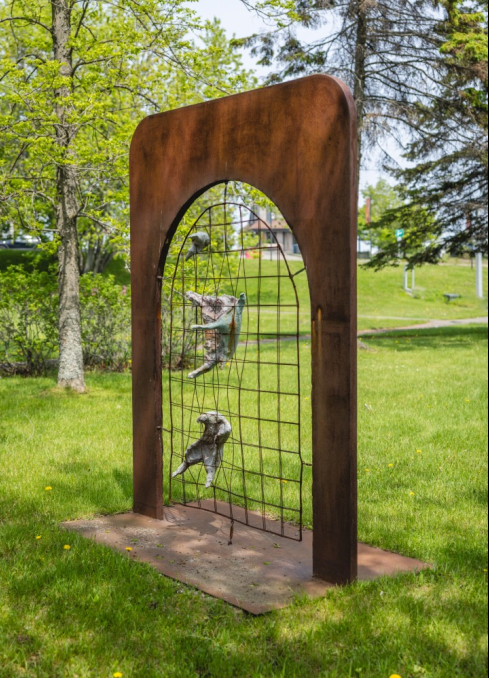
La trappe features an arch within which a wire mesh is stretched. Trapped between the metal wires are organic-looking forms that seem caught in a snare. Their colour and texture evoke animal carcasses, and their silhouettes suggest four elongated limbs, now reduced to stumps. These mutilated bodies stir nightmares lurking in our collective unconscious while also confronting us with the violent realities of the human condition.
Despite its disturbing nature, La trappe is ultimately a call for outrage in the face of the great tragedies of our time. It urges both personal and collective action, awakening our capacity to resist in a world numbed by violence.
What emotions does this piece stir in you, and why?
 Dominique Valade
Aluminum, granite, stones, plants
Collection: Musée du Bas-Saint-Laurent
Jardins du Musée - Inaugurated in 2003
Dominique Valade holds a Master of Fine Arts degree (1994) and a PhD in Arts Studies and Practices (2004) from the Université du Québec à Montréal, where she focused on the reinterpretation of landscapes in sculptural work. In the 1990s and 2000s, she created a series of installations on the notion of the dwelling, exploring a wide array of elements that surround or form the human habitat.
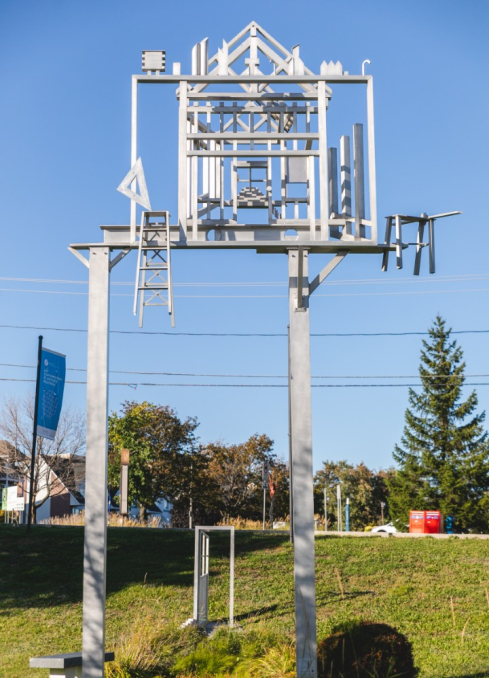
Presented together in a single installation, Habitacle and Projection de l’habitacle invite reflection on the relationship between humans and nature, drawing upon the concept of landscape. Unlike nature, landscape is a human invention, created through framing, composition and perspective. Habitacle consists of two imposing pillars supporting the frame of a house under construction. Surrounded by shrubs and flowers, a pathway leads to another, smaller yet equally evocative structure. Projection de l’habitacle takes the form of a landscape with an open door at its centre.
Through this sculptural ensemble, Valade addresses not only the idea of the home and habitat but also representation, imagination and dreams. She demonstrates, in three dimensions, that landscape exists beyond paintings and is brought to life through our very gaze.
What do you think lies beyond the slightly open door?
 Ulysse Comtois
Painted steel
Collection: Musée du Bas-Saint-Laurent
Entrée principale du Musée - Inaugurated in 2001
Quebec sculptor and painter Ulysse Comtois (1931–1999) studied at the École des beaux-arts de Montréal in the late 1940s, but soon grew disenchanted with its traditional methods, drawn instead to the avant-garde movements of the time. Known for his modular, abstract sculptures, he was one of the first Canadian artists to begin working with welded metal in the early 1960s.
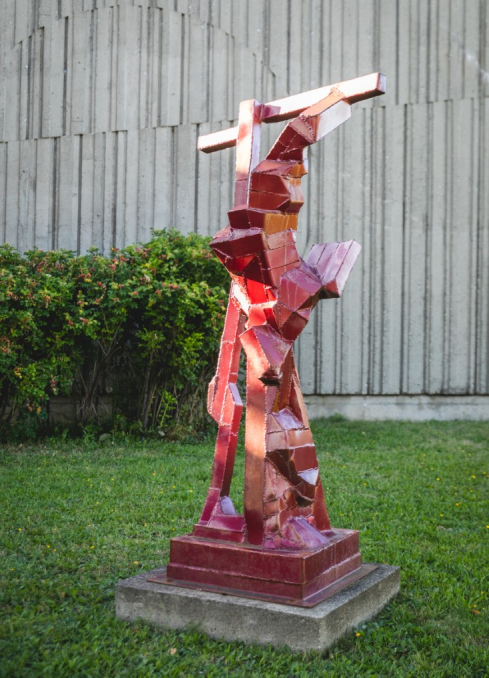
The sculpture Héraut—named after a herald, a figure tasked with announcing the arrival of someone or something—is composed of interlocking geometric and organic shapes that suggest motion. With its mechanized human form, the piece speaks to the relationship between humans and machines. The work’s ambiguity, arising from the blurred line between person and mechanical object, is heightened by the bold red that coats every element, emphasizing the fusion of human and machine within a single sculptural entity.
Welding gave Comtois the freedom to assemble his forms with a dynamic energy that echoes the chaos of the natural world. His explorations of the tensions between order and disorder, freedom and constraint, beauty and ugliness would go on to influence a generation of artists seeking to break away from the conventions of traditional sculpture.
If this sculpture were a person, what would they be doing? And if it were a machine, what might it be used for?
 Bill Vazan
Sandblasted granite
Collection: Musée du Bas-Saint-Laurent
Entrée principale du Musée - Inaugurated in 2004
Born in Toronto in 1933, Bill Vazan studied at the Ontario College of Art and Design, the Beaux-Arts de Paris school and Sir George Williams University in Montréal, where he settled in 1957. Motivated by the desire to bring Montréal and Quebec into an international network, he was instrumental in founding Véhicule Art (Montréal) Inc., a major artist-run centre that showcased contemporary and experimental practices during the 1970s.
Rooted in the belief that nature and humanity are deeply interconnected, his artistic process draws inspiration from land art—an art movement that began in the 1960s focusing on creating artworks directly in and with the landscape. Throughout his career, Vazan has created an extensive body of carved stone works bearing symbolic motifs. These engravings often reference the marks left by human presence on the land.
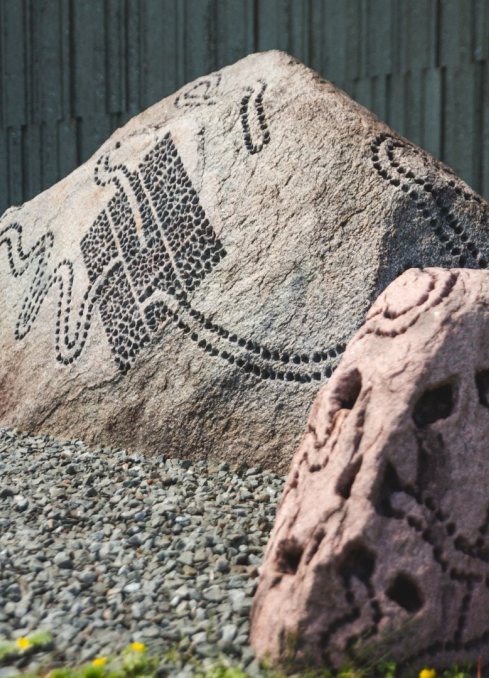
The sculptures Grid with Superstrings and Sans titre both feature forms that are simultaneously organic and geometric, evoking the relationship between human beings and the universe. The engraved lines winding across the granite create a kinaesthetic experience that calls to mind the imprint of omnipresent natural forces, as well as the memory of ancient civilizations.
What do the engraved patterns on the granite make you think of?
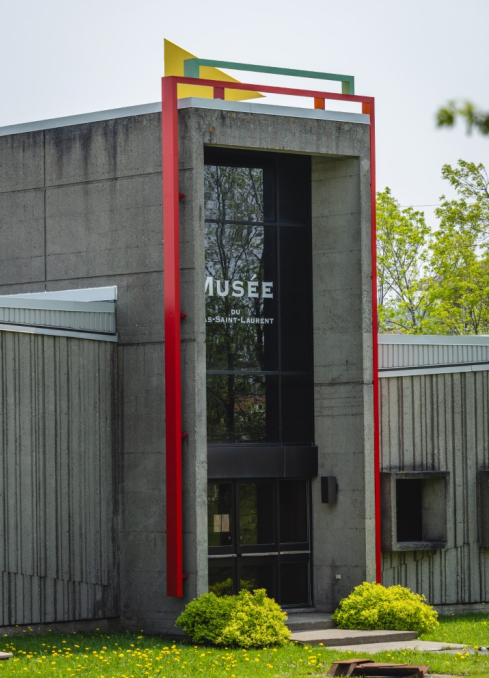 Michel Lagacé
Painted aluminum
Collection: Musée du Bas-Saint-Laurent
Entrée principale du Musée - Inaugurated in 1986
Hailing from Rivière‑du‑Loup, Michel Lagacé holds both a Bachelor’s degree and a Master’s degree in Fine Arts from the Université du Québec à Montréal. He taught at the Cégep de Rivière-du-Loup arts department from 1976 to 2010 and has been actively involved with Voir à l’Est art contemporain, a collective of artists from the Bas‑Saint‑Laurent region, from its inception in the late 1990s. In his artistic practice, Lagacé has a strong interest in shapes and colours, which he expresses through paintings and public art projects.
Located in the main section of the Musée du Bas‑Saint‑Laurent, Signal draws attention to the two entrances of the building. The colourful metal structure, which rises above and frames the architecture, contrasts with the starkness of the concrete exterior through its vibrant colours and geometric lines. The artist designed Signal to highlight the building’s facade, accentuating its openings, which serve as gateways to knowledge.
The work was created in the context of the expansion of the Centre d’animation et de diffusion culturelles du Bas‑Saint‑Laurent, which opened in 1975 under the name Musée d’archéologie de l’Est du Québec and is now known as the Musée du Bas-Saint-Laurent. Signal is part of Lagacé’s ongoing experiments with signs and architecture. Since the 1980s, the artist has explored issues related to signage and the demarcation of spaces. Reflecting the museum’s various missions since its creation, the installation acts as a thread connecting them all, demonstrating the importance the MBSL places on the transmission of knowledge through the ages.
Signal frames the museum’s two entrances. Cross the street to take in the full view.
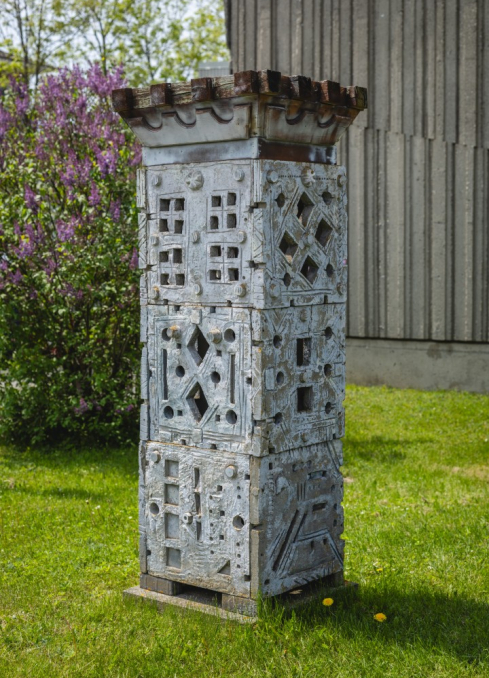 Louis Belzile
Cement, fibreglass, wood
Collection: Musée du Bas-Saint-Laurent
Entrée principale du Musée - Inaugurated in 2000
Originally from Rimouski, painter and sculptor Louis Belzile (1929–2019) studied at the Ontario College of Art and Design in Toronto from 1948 to 1952, then with Cubist painter André Lhote in Paris from 1953 to 1954. He was one of the four signatories of the Manifeste des plasticiens (1955), which advocated for an approach to painting based on formal elements: tone, texture, colour, form and line.
A rare sculptural work by the artist, Les trois âges stands apart from his contemporary painting practice, in which he explored the effects of light. This three-dimensional piece takes the form of a column composed of twelve sculpted concrete segments topped with a moulded wood cap. Its materials call to mind the built environment, referencing architecture and offering a fresh perspective on these familiar elements.
The stacking of openwork panels results in a mysterious structure, somewhere between a small-scale model and an abstract sculpture. True to Belzile’s artistic language, simple geometric forms are used here to create varied openings and textures in the concrete. Although a departure from the artist’s usual medium, Les trois âges offers a compelling insight into the artist’s broader exploration of depth at the time.
Take a close look at how the light plays through the sculpture.
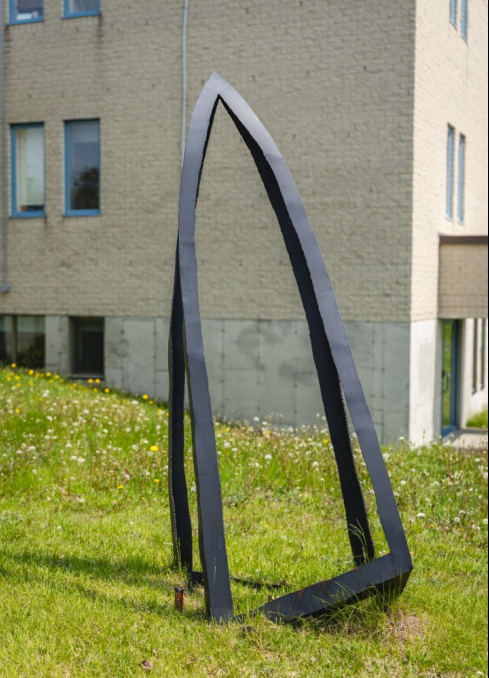 Jean-Pierre Morin
Painted steel
Collection: Musée du Bas-Saint-Laurent
Stationnement du Musée - Inaugurated in 2000
Originally from Saint-Anselme, Jean‑Pierre Morin studied at the École de sculpture de Saint-Jean-Port-Joli (1968–1971), then earned a Bachelor of Fine Arts degree from Université Laval (1978) in Québec City, followed by a Master of Fine Arts degree from Concordia University (1984) in Montréal. Since the 1980s, the sculptor has drawn inspiration from organic forms to create works that engage with the living world and nature.
Icare is composed of four long, irregular edge pieces joined at their tips, giving the sculpture the appearance of an arrowhead carved from stone or forged from ancient metals. Hollowed out and unevenly grounded, the structure points skyward. Its title refers to the ill-fated Icarus of Greek mythology who ignored his father’s warnings and flew too close to the sun.
Echoing classical antiquity both in name and form, Icare evokes the idea of ascension. The study of movement is a recurring concern in Morin’s practice, with many of his sculptures capturing elusive or unstable phenomena. These are given an unusual sense of presence and duration, heightened by the work’s scale and its permanent anchoring within the landscape.
This sculpture refers to the Greek myth of Icarus. Does its form suggest a sense of flight or of falling?
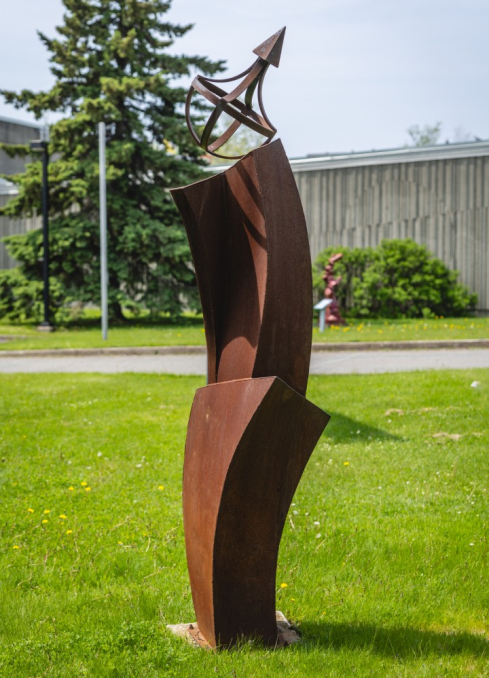 Claude Millette
Corten steel, painted
Collection: Musée du Bas-Saint-Laurent
MRC de Rivière-du-Loup 310, rue Saint-Pierre - Inaugurated in 2002
Born in Saint-Hyacinthe, Claude Millette studied at the École de sculpture de Saint-Jean-Port-Joli from 1975 to 1976, and then apprenticed with sculptors Jordi Bonet (1977) and Robert Poulin (1979). He soon developed a deep interest in metals and committed himself to an artistic approach driven by a constant desire to experiment with materials. He seeks to bring a sense of sensuality to raw, rigid materials, particularly steel.
The sculpture Générescence consists of three stacked volumes with curved lines. Two rectangular shapes, standing one on top of the other, give the impression of fluidity despite their considerable mass. Resting on the second module, a truncated globe tilts toward the ground. Its other side stretches out like an arrow, pointing toward the sky. Together, the three volumes evoke a figure dancing beneath the heavens, anchored firmly to the earth while reaching for the stars.
Movement is central to Millette’s practice, both in the themes he explores and in the execution of his sculptures. By transforming the material, he engages his whole body in the process, channeling a sense of form and expression into the metal. The work takes shape through the artist’s gesture, with his energy forever etched into the heart of the composition.
What stands out most to you in this work: lightness or solidity?
 François Maltais
Steel, aluminium, copper, stainless steel
Collection: MRC de Rivière-du-Loup
MRC de Rivière-du-Loup, 310 rue Saint-Pierre - Inaugurated in 2013
Originally from the Lac‑Saint‑Jean region and now based in Rivière‑du‑Loup, artist François Maltais holds an interdisciplinary Bachelor of Fine Arts degree from the Université du Québec à Chicoutimi. Actively involved in the cultural scene, he taught at the Cégep de Rivière-du-Loup arts department from 1999 to 2023 and served as the artistic director of the intercollegiate snow sculpture competition from 2015 to 2023.
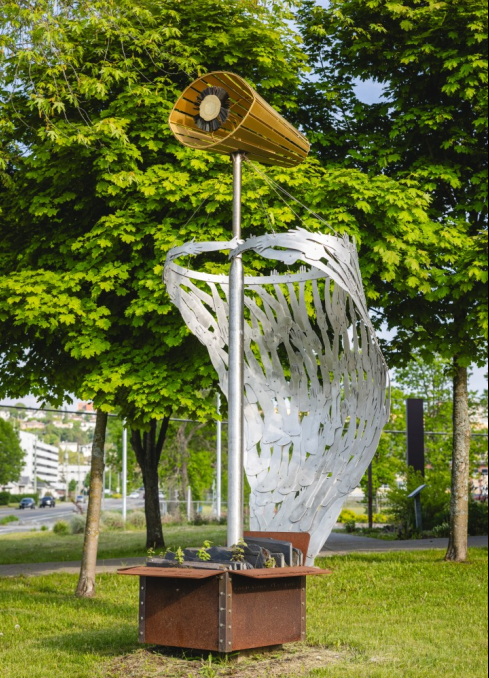
The sculpture Le visionnaire takes the form of an imaginary vessel, at the top of which sits an eye turned towards the horizon. The iris is composed of dozens of copper plaques, each holding the vision of the future of the people of Rivière-du-Loup. Through a creative process involving the community, Maltais invited both children and adults to share their hopes and commitments for the future, which were later engraved on the plaques. Made up of dozens of outstretched arms, the sail incorporates the arms of participants, photographed by the artist and then cut out from aluminum.
Inaugurated in 2013, the work was created to highlight the 2011–2031 strategic vision of the RCM of Rivière-du-Loup, which focuses on positioning the community for the future. A symbol of collective desires, Le visionnaire stays on course toward a future defined by creativity, commitment and innovation.
The words engraved on the base of the sculpture express the hopes and commitments of children and adults for the future. What would yours be?
 David Sorensen
Welded and painted steel
Collection: Musée du Bas-Saint-Laurent
MRC de Rivière-du-Loup, 310 rue Saint-Pierre - Inaugurated in 2002
Born in Vancouver, David Sorensen (1937–2011) studied under architect Arthur Erickson, sculptor Iljuwas Bill Reid and painter Jack Shadbolt before settling in Quebec in the mid-1960s. Drawn to Quebec modern art, Sorensen developed an artistic approach grounded in abstraction and expressiveness. He is especially known for his painting, where he sought to convey the personal impressions left by the places he visited and inhabited.
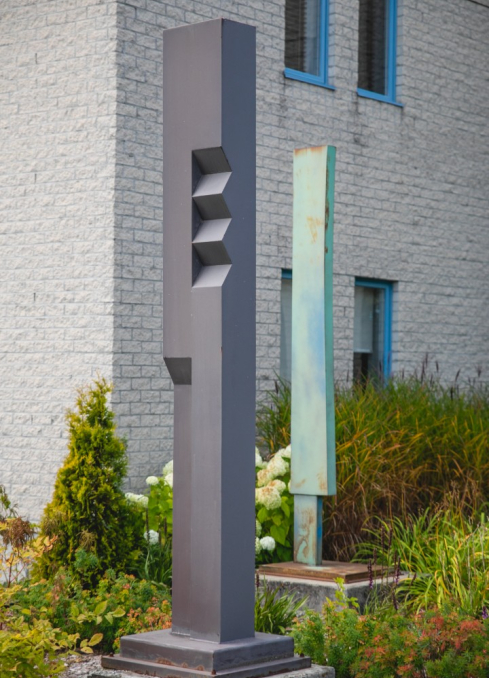
Millenium Stele A (AGX 1) and Millenium Stele B (AGX 2) are two geometric structures made up of vertically standing rectangles. Minimalist and linear in appearance, the narrow, elongated metal forms recall the silhouette of buildings stripped of all ornament. Their colours reference the hues of metal: blue-green evokes oxidized copper, while grey suggests raw steel.
The Millenium Stele sculptures reflect the artist’s interest in architecture and materiality. Despite their industrial appearance, they embody a profound connection to the human mind and human activity. They highlight metal as both material and subject, with its history closely tied to human progress, and point to the human presence behind every architectural and technical endeavour.
What connections do you notice between these sculptures and the nearby building?
 Claude Millette
Steel
Collection: Musée du Bas-Saint-Laurent
Parc du Campus-et-de-la-Cité, coin rue Saint-Pierre et rue Desjardins - Inaugurated in 2010
Born in Saint-Hyacinthe in 1957, Claude Millette studied at the École de sculpture de Saint-Jean-Port-Joli from 1975 to 1976, and then apprenticed with sculptors Jordi Bonet (1977) and Robert Poulin (1979). He soon developed a deep interest in metals and committed himself to an artistic approach driven by a constant desire to experiment with materials. He seeks to bring a sense of vitality to raw, rigid materials, particularly steel.
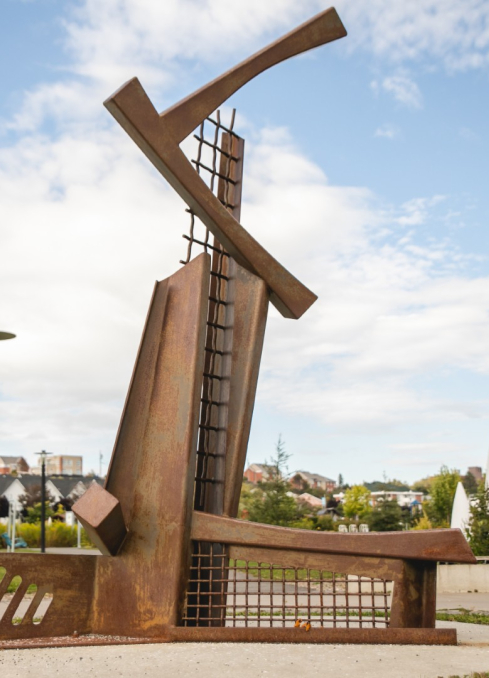
The sculpture Gyrostatique combines the forms and textures of steel in a choreography where flexibility meets rigidity, balance meets instability and stillness meets movement. The interweaving of linear forms, grids and curved lines generates energy within the sculpture. Inspired by dance, where energy arises from tensions between bodies or limbs, Millette creates his works through effects of juxtaposition and opposition.
The title of the sculpture brings together two antithetical ideas: “gyro,” referring to rotational movement, and “static,” which refers to stillness. Similarly, the structure combines solids and voids to sharpen our visual perception. On the very edge of logic, Gyrostatique reflects the artist’s exploration of the idea of confrontation.
Walk around the sculpture and imagine it spinning in the wind.
 Ludovic Boney
Painted aluminum, cedar
Collection: Ville de Rivière-du-Loup
Parc du Campus-et-de-la-Cité - Inaugurated in 2010
Born in Wendake in 1981, Huron-Wendat artist Ludovic Boney studied sculpture at the Maison des métiers d’art de Québec and began working on public art projects early in his career. Known for his large-scale, colourful works, he plays with codes and materials to create contrasting compositions that blend cultural tradition with contemporary form.
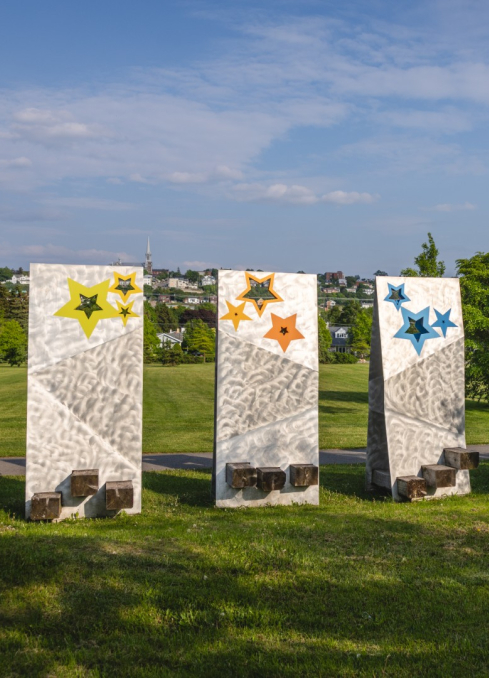
The installation Fleur d’assise consists of five aluminum modules, each perforated with multi-coloured stars and intersected by three cedar beams. Like a line of train carriages unfurling along the path, the work speaks to the historic importance of the railway network in the development of Rivière‑du‑Loup. Arranged in a zigzag pattern, the sturdy wooden beams appear to be set in motion, calling to mind the movement of old locomotive wheels.
At the same time, Fleur d’assise echoes the surrounding natural environment. The folds disrupting the line of the metal evoke the rocky surfaces of nearby outcrops and the smaller waterfalls near the impressive Rivière‑du‑Loup falls. At night, the colourful stars align with the celestial bodies above, symbolizing a constant human presence and our long history of looking to the stars.
Step back to observe the motion created by the folded metal and the placement of the wooden beams.
 Marcel Braitstein
Painted steel
Collection: Musée du Bas-Saint-Laurent
Bureau d'information touristique de Rivière-du-Loup 189, boul. de l'Hôtel-de-Ville - Inaugurated in 2002
Born in Belgium in 1935, artist and writer Marcel Braitstein immigrated to Canada in 1951. A graduate of the École des beaux-arts de Montréal, he taught in the Department of Visual Arts (now the École des arts visuels et médiatiques) at the Université du Québec à Montréal from 1969 to 1998. Braitstein’s enduring sources of inspiration include the human condition and the natural world, which emerge in his exploration of themes such as death and destruction in both his sculptural and literary work.
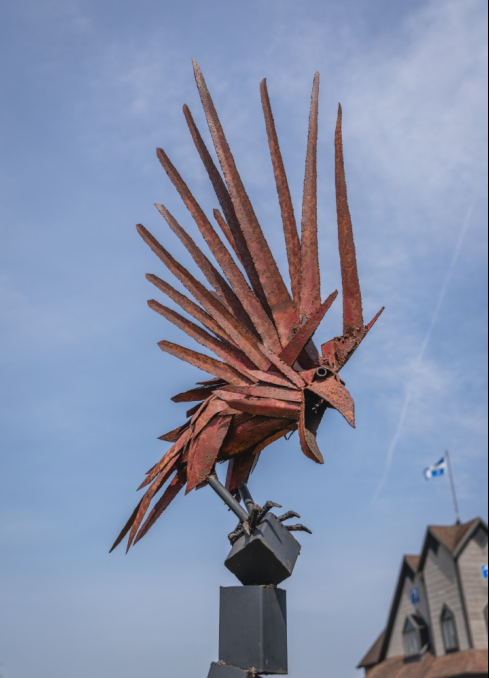
Oiseau sur colonne depicts a bird perched atop a fractured column. With wings outstretched, beak agape and claws extended, the bird strikes a menacing pose. Created using welded metal, the sculpture features sharp, jagged elements that, combined with bright red paint, heighten its expressive, unsettling character. The bird’s plumage, typically soft and downy, appears rigid and blade-like, as sharp as a sword.
Part of the artist’s ongoing exploration of animal figures, Oiseau sur colonne reflects Braitstein’s fascination with both real and mythical creatures. Of Jewish heritage, he often draws from this imagery to evoke the horrors of war, which he experienced first-hand during the German occupation of Belgium in World War II.
As you look at the sculpture, what relationship do you see between the bird and the column? What do you think this interaction might represent?
 Guerino Ruba
Bronze
Collection: Musée du Bas-Saint-Laurent
Cégep de Rivière-du-Loup, entrée des résidences au 325, rue Saint-Pierre - Inaugurated in 2003
Born in Pola, Italy (now Pula, Croatia), in 1940, Guerino Ruba moved to Montréal in 1967, where he studied sculpture at the Université du Québec à Montréal. He went on to teach in the Fine Arts Department at Cégep du Vieux Montréal until 2004. A committed and uncompromising artist, Ruba creates powerful works that confront the darker side of humanity. War, cruelty and death are recurring themes in his work.
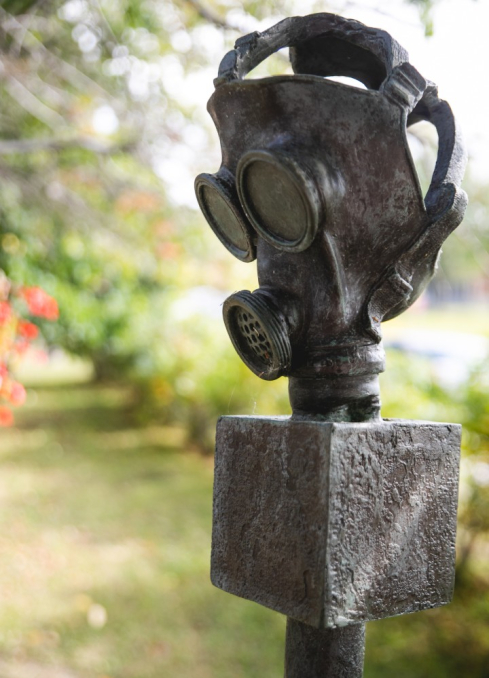
The Giocolieri series, comprising Giocoliere I, II and III, references the figure of the jester, the entertainer of royalty. Meaning “jugglers” in Italian, Ruba’s giocolieri blend circus imagery and Italian commedia with allusions to the French Revolution, an extremely violent time that saw the fall of the absolute monarchy.
Facing Giocoliere II and III, Giocoliere I stands out for its specific motifs. A crown resting on a throne is set atop a rectangular form reminiscent of a guillotine. In front of this royal symbol, two strange juggling figures appear frozen mid-performance: one with a face brutally slashed, the other wearing a gas mask.
If this sculpture were telling a story, what would it be?
 Denis Beauséjour, Youri Blanchet et François Maltais
Torrified wood, Painted metal
Collection: Cégep de Rivière-du-Loup
Cégep de Rivière-du-Loup, coin rue Saint-Pierre et rue Frontenac - Inaugurated in 2021
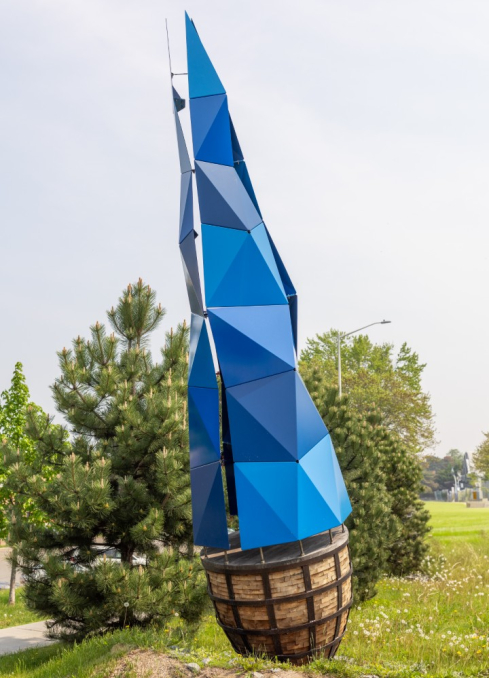
Through their individual artistic practices and careers teaching at the Cégep de Rivière-du-Loup arts department, artists Denis Beauséjour, Youri Blanchet and François Maltais actively contribute to enriching the regional cultural landscape. Together, they created the sculpture Se tenir debout et rayonner, aimed at highlighting the pivotal role of the Cégep since its founding in 1969.
Slightly tilted, the work consists of an oval shape that stretches toward the sky in a striking geometric trail. It resembles a buoy guiding ships, also symbolizing the beacons offered by education. The surrounding landscaping mimics the undulating motion of a wave, giving the structure a sense of floating. The installation thus links learning with the river that defines the Cégep’s environment.
Reflecting the spirit of camaraderie that permeates the institution, Se tenir debout et rayonner references the origins of the Cégep, which was established through community mobilization. The verticality of the piece also evokes the personal and collective growth sparked by education. Anchored in the past yet reaching toward the future, the sculpture not only testifies to the socio-economic and cultural significance of this college, but also highlights its deeply collaborative nature.
The artists drew inspiration in part from a maritime buoy. What connections do you see between education and a buoy?
 Charles Daudelin
Corten steel
Collection: Ville de Rivière-du-Loup
Centre Premier Tech, 75 rue Frontenac - Inaugurated in 2006
Born in Granby, Charles Daudelin (1920–2001) moved to Montréal in 1939, where he studied at the École nationale du meuble, notably under the tutelage of Paul-Émile Borduas. A pioneer in integrating art with architecture, Daudelin paved the way for monumental sculpture in public spaces. He dedicated his life to creating public art projects that fostered connections with people and generated collective spaces, a commitment he maintained until his death.
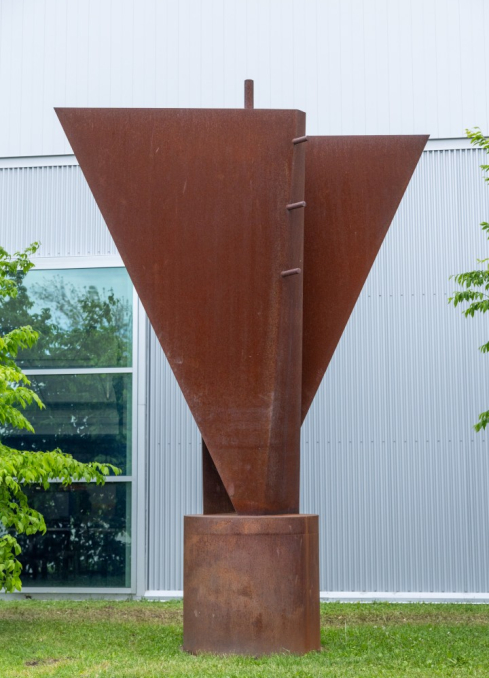
In the 1980s, the sculptor explored the technique of folding, creating several models based on this theme, which enabled him to shape materials and breathe life into his sculptures. In 1986, he created Émérillon, a small-scale brass sculpture that served as a trophy for the France-Canada cinema and audiovisual awards. In 2005, the Ville de Rivière‑du‑Loup acquired a larger version made of steel.
Émérillon in French refers to the small Merlin falcon, envisioned here with its wings unfurled, also evoking a sailing boat. The piece reflects Daudelin’s artistic interests in geometry, the interplay between voids and solids, and the balance between instability and equilibrium. Revealing the clear folds of the original model, this large sculpture stands as a remarkable example of Daudelin’s distinctive volumetric style.
Move around the sculpture to see both the wings of a falcon and the sails of a boat.
 Cooke-Sasseville
Painted metal
Collection: Ville de Rivière-du-Loup
Stade de la Cité des jeunes 75, rue Frontenac - Inaugurated in 2021
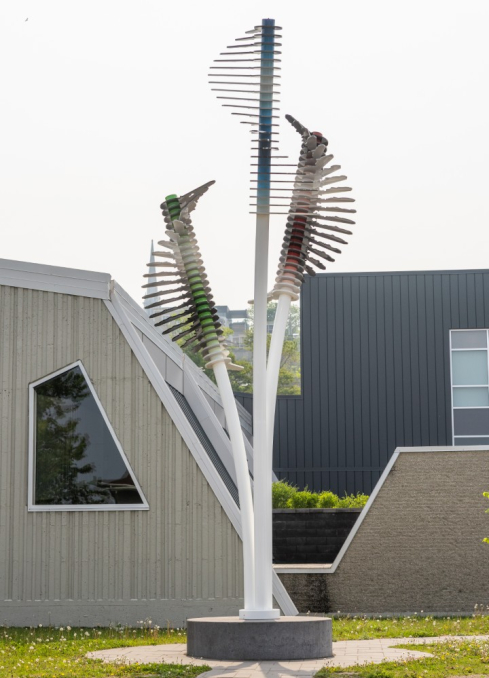
Artists Jean-François Cooke and Pierre Sasseville have been working together under the name Cooke-Sasseville since 2000. Their artistic practice is defined by the unlikely pairing of often mundane elements, whose meaning and function are subverted through shifts in scale and striking scenography. The duo creates a body of work infused with humour, rooted in Quebec’s distinct identity, and peppered with nods to popular culture and political or economic current events.
The sculpture Jeu de clés consists of three masts topped with an array of keys arranged in a fan shape. By definition, a key (the word clé, in French) is used to lock or unlock. It also features in many everyday expressions, such as “the key to the problem,” where it symbolizes a solution. The expression “turnkey” suggests that everyone possesses the tools they need to thrive.
In Jeu de clés, each key represents the profile of a human face. These many anonymous figures, cut into the bit—the part of the key used to lock or unlock—underscore the importance of each individual’s role within a social whole. Without the bit, all keys would be identical; it is this detail that makes each one unique.
Each mast in the sculpture displays a cluster of keys, each cut with a unique profile. What might this piece represent?
 Gilles Girard
Brushed aluminum
Collection: Centre de services scolaire Kamouraska-Rivière-du-Loup
Pavillon-de-l’Avenir, entrée rue Landry - Inaugurated in 1996
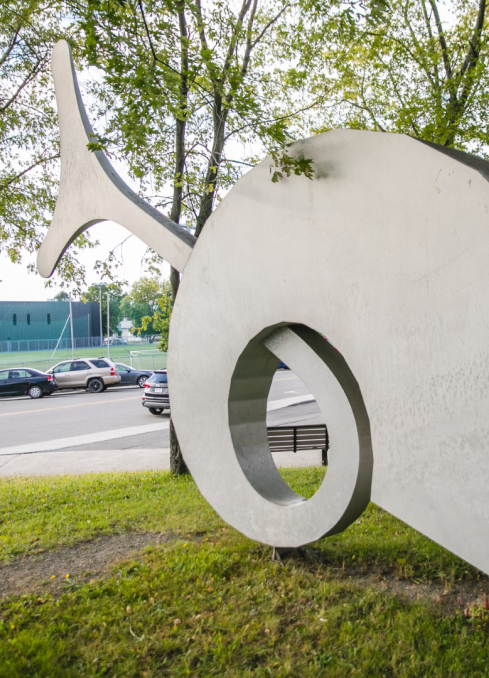
Originally from Price and now based in Matane, sculptor Gilles Girard holds a Bachelor of Fine Arts degree from Université Laval in Québec City. Constantly in search of graphic elegance in space, he builds sculptural creations inspired by animal forms and marked by dynamic lines.
Croissance, développement, devenir unfolds in a gigantic spiral whose upper tip reaches skyward. The structure resembles a massive snail, bearing a rounded shell and stretching out its antennae. Despite the mollusc’s reputation for slowness, the work is full of movement; it seems to be launching itself forward at full speed. The resulting image is a curious contradiction, combining opposing concepts: the animal’s inertia and the spiral’s dynamic design, the limpness of a soft body and the rigidity of metal, the mineral mass of the shell and the lightness of aluminum.
The sculpture Croissance, développement, devenir stands in stark contrast to its surroundings, yet manages to harmonize with the natural ecosystem in which it is set. Part of a body of work inspired by the animal world and fuelled by imagination, the piece reflects the artist’s fascination with creatures of all kinds. It contributes to the creation of a strange bestiary, one in which the giant snail undoubtedly holds a unique place.
Which elements of the sculpture symbolize growth? Which ones represent development and becoming?
 Yves Trudeau
Welded bronze
Collection: Centre de services scolaire Kamouraska-Rivière-du-Loup
Pavillon-de-l’Avenir, entrée rue Sainte-Anne - Inaugurated in 1968
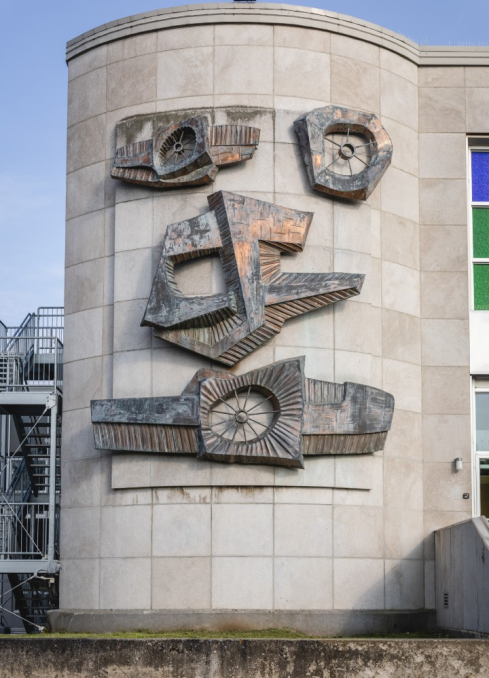
Born in Montréal, Yves Trudeau (1930–2017) began studying art as a teenager and launched his sculpting career in the late 1950s. Actively involved in several professional organizations, he was a founding member of the Association des sculpteurs du Québec, playing a key role in the creation of the Musée d’art contemporain de Montréal.
Reliefs is an installation made up of five large-scale units arranged in a way that suggests a face. Towering in scale, the figure protrudes from the curved facade while blending seamlessly with the building’s architecture. The texture and shape of the modular elements recall the distinct features of a mouth, nose and two eyes. The work reflects Trudeau’s interest, during this period, in incorporating human references into his practice.
In the 1960s, he began exploring the idea of mobility through static forms. The recurring motif of wheels or gears in Reliefs expresses the tensions he sought to create between movement and stillness. The installation also reveals some of the concerns that would shape his later work, such as the relationships between container and contained, interior and exterior, openness and enclosure, inclusion and integration.
Besides a face, what else could the arrangement of components represent?
 Émilie Rondeau
Cut, engraved and painted anodized aluminum, galvanized steel, digital print
Collection: École de musique Alain-Caron
École de musique Alain-Caron 75, rue Sainte-Anne - Inaugurated in 2010
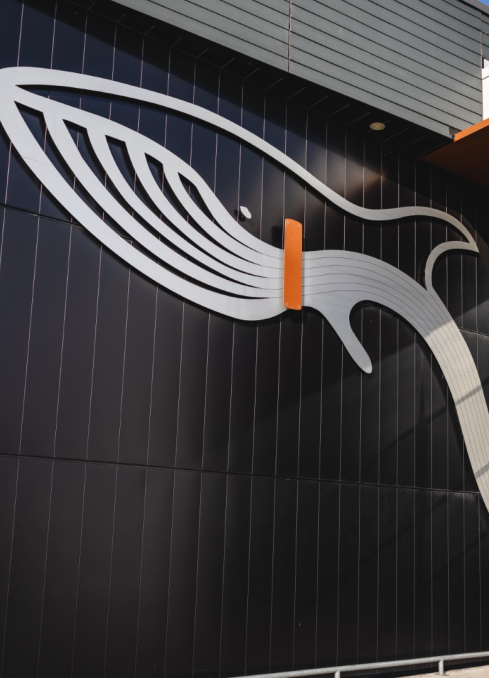
Originally from Saint-Hyacinthe and now based in Rivière-Ouelle, artist Émilie Rondeau holds a Bachelor of Fine Arts degree from Concordia University in Montréal and a Master of Fine Arts degree from the Nova Scotia College of Art and Design in Halifax. Through processes aimed at distorting the senses and blending references, she creates dreamlike works that combine the real and the imaginary.
Vocalises d’une baleine à cordes merges the silhouette of a fin whale, present in the St. Lawrence Estuary near Rivière-du-Loup, with the iconic bass guitar of jazz musician Alain Caron, a native of Saint-Éloi, after whom the music school where the sculpture stands is named. Reflected by the mirrored effect of the building’s glass entrance, the curves of the whale's body blend playfully with those of the stringed instrument. Inside the building, the neck of the guitar extends into a panoramic landscape representing the view of the river and the mountains facing the city.
The undulating lines throughout the piece echo the musical compositions of the bassist and the role of the École de musique Alain-Caron, as well as the whale's song and the river’s ripples. Reimagining the surrounding environment, the "stringed whale" encourages us to see our surroundings in a new light.
Did you know this artwork continues indoors? Feel free to step inside to experience the full piece.
 Tatiana Démidoff-Séguin
Vitrified cast cement, steel
Collection: Musée du Bas-Saint-Laurent
118, boul. Hôtel-de-Ville - Inaugurated in 2003
Note: This installation will be installed in the museum gardens during the 2026 summer.
Of Russian and French descent and born in Algeria, artist Tatiana Démidoff-Séguin (1935–2006) moved to Quebec in 1962 after studying art in Paris and Algiers. A co-founder of Espace, a magazine dedicated to contemporary sculpture, she became a key figure in Quebec’s sculptural scene through both her artistic practice and her deep commitment to the field.
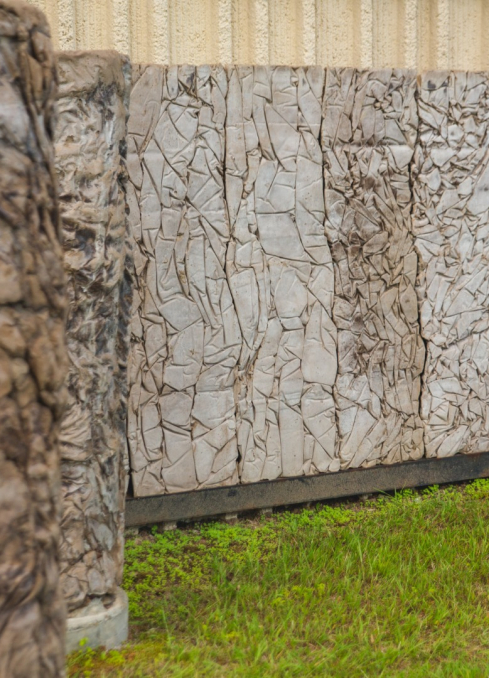
Transmutation is a cement installation composed of three columns, each weighing 500 pounds (225 kg), and a bas-relief weighing 6,800 pounds (3,000 kg). Despite its considerable weight, the piece appears deceptively light, as though made from a soft, crumpled material. The polished surfaces, marked by folds and creases, give an impression of pliability that defies the very nature of cement. Démidoff-Séguin thus plays with visual perception, casting doubt on the material reality of the work.
Transmutation was created with a trowel, a tool used in masonry for spreading paste-like materials and in art for applying paint to canvas. This technique blends references to both modern art and the world of construction. Alongside the traces left by the production process, the artist’s hand is clearly present, inviting reflection on the hierarchy of materials, some historically deemed “noble,” others “humble,” and prompting us to question our assumptions.
This work features a variety of textures. Why not take a moment to feel them?
 Pierre Leblanc
Painted steel, stone
Collection: Musée du Bas-Saint-Laurent
Parc Blais, coin rue Lafontaine et rue du Rocher - Inaugurated in 2002
Born in the Côte‑Saint‑Paul neighbourhood of Montréal in 1949, Pierre Leblanc learned the fundamentals of sculpture under the guidance of artist André Fournelle. His birthplace, shaped by working-class life, and the transformational shifts in the urban and social landscape continue to influence his artistic practice. In his work, he delves into his own past as well as our collective history. Themes of memory and the relationship with architecture are central to many of the sculptor’s projects.
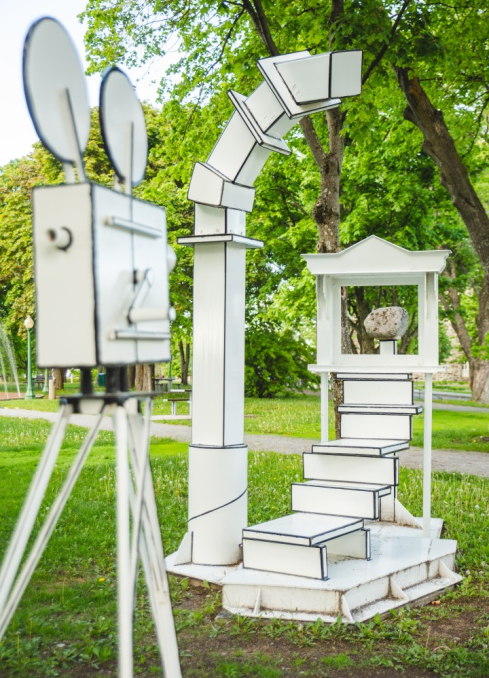
The installation Mémoire consists of two structures assembled like a stage set, made from geometric forms. The first resembles an old hand-crank film camera and stands in front of the second, which evokes a film set. An arched column rises above an asymmetrical staircase, at the top of which rests a window. Framed within the opening, a round stone placed on a small column forms the focal point of the piece.
The stone’s organic, tactile presence stands in stark contrast to the white geometric structures, whose black edges highlight their artificial, constructed appearance. By drawing attention to the stone’s materiality and natural form, Leblanc reveals his reasoning: the focus on the organic world expresses a critical view of consumer society and its impact on the environment.
Why do you think a stone was used as the centrepiece of this work?
 Tatiana Démidoff-Séguin
Vitrified cast cement, steel cable, cement
Collection: Musée du Bas-Saint-Laurent
Devant le Théâtre de la Goélette 67, rue du Rocher - Inaugurated in 2004
Of Russian and French descent and born in Algeria, artist Tatiana Démidoff-Séguin (1935–2006) moved to Quebec in 1962 after studying art in Paris and Algiers. A co-founder of Espace, a magazine dedicated to contemporary sculpture, she became a key figure in Quebec’s sculpture scene through both her artistic practice and her deep commitment to the field.
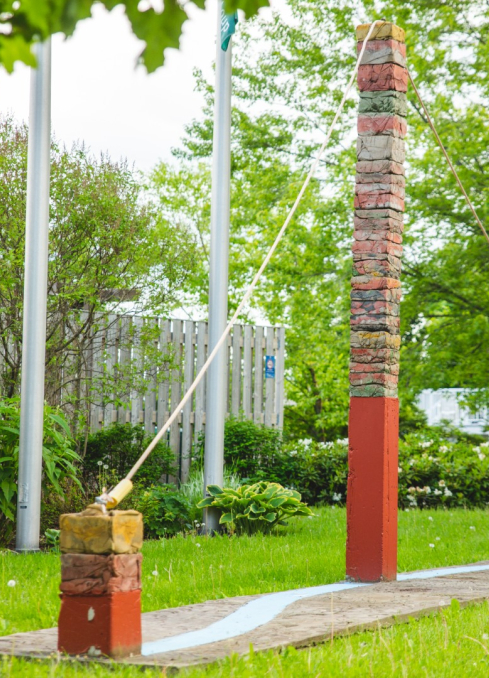
The sculpture Chan Jòdla—named after a Creole phrase meaning “Today is my lucky day”—is part of a series created in Guadeloupe and inspired by the Caribbean archipelago’s environment. It takes the stylized form of a boat, representing its three iconic parts: the bow, mast and stern. Each is made from coloured cement components stacked on a reddish base and connected by a steel cable to suggest the outline of a vessel.
When the sculpture was unveiled in 2008, the artist invited people to leave their mark in the cement base that supports the poles, as she had done in earlier works. This participatory gesture reflects a core aspect of her practice: a collective dimension that not only becomes visible in the work but also helps shape its very foundation.
If the sculpture represents a boat, what story might its title, which translates to “Today is my lucky day,” be telling you?
 Marie-Fauve Bélanger
Granite, painted aluminum
Collection: Ville de Rivière-du-Loup
Bibliothèque Françoise-Bédard, entrée côté ouest 67, rue du Rocher - Inaugurated in 2023
Originally from Lac‑Saint‑Charles, Marie‑Fauve Bélanger holds a Bachelor of Fine Arts and Media Arts degree from Université Laval and a diploma from the Maison des métiers d’art de Québec. Rooted in a practice informed by environmental experience, her work resembles organic and geological fragments where nature and culture intertwine.
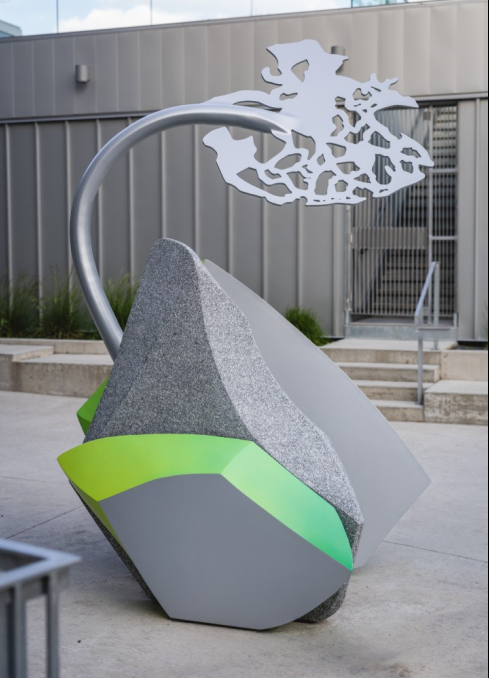
The sculpture Semence is composed of an assemblage of vertical layers, at the centre of which rises a curved stem topped with an openwork leaf. As its title suggests, the piece represents a seed in the process of germinating. Delicately shedding its outer shell to make way for its first shoot, the seed anchors itself in the earth even as it reaches up towards the sun. The juxtaposition of natural and manufactured materials, enriched by varied textures and colours, mirrors the surrounding environment.
From a tiny seed, a towering tree can grow. With the potential to give rise to an entire plant, the seed symbolizes the origins of life and the birth of ideas. Semence brings to mind all the magnificent trees that populate our world, silent witnesses to our lives. It encourages us to reflect on the significance of the things around us, even the most delicate sprout.
What connection do you see between this artwork and reading?
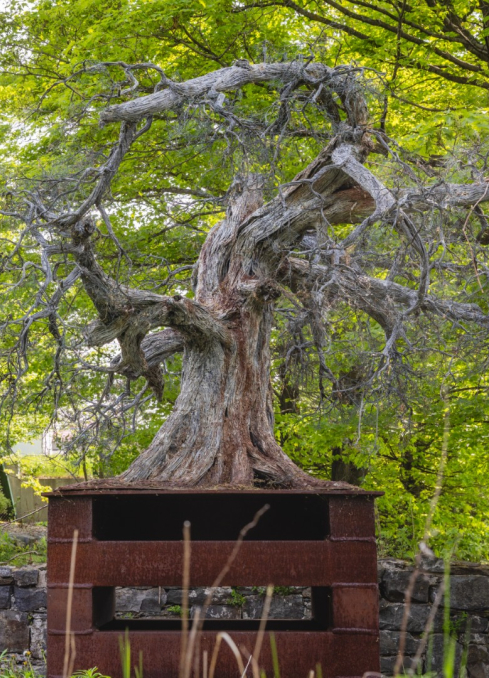 Dominique Valade
Copper wire, steel, stone, plants
Collection: Musée du Bas-Saint-Laurent
Jardins du Manoir Fraser 32, rue Fraser - Inaugurated in 2004
Dominique Valade holds a Master of Fine Arts degree (1994) and a PhD in Arts Studies and Practices (2004) from the Université du Québec à Montréal, where she focused on the reinterpretation of landscapes in sculptural work. In the 1990s and 2000s, she created a series of installations on the notion of the dwelling, exploring a wide array of elements that surround or form the human habitat.
The installation De la cime aux racines : la nature comme abri features two complementary assemblages. On one side, an old apple tree made from copper wire rests on an overturned metal crate. Surrounded by plants, it is enclosed by four ancient stone walls, likely remnants of the Fraser Manor stable. On the other side, a structure crowned with a telescope shelters a tree whose foliage inversely covers its frame.
In dialogue with the historical remnants and vegetation of the site, the piece blends natural and artificial elements to evoke the theme of habitat and the role nature plays in it. De la cime aux racines : la nature comme abri blurs the boundaries between the built and natural environments, highlighting the reciprocal relationships that transform a space into a place of life.
Considering the title [from the crown to the roots, nature is shelter] and the two parts of the work, what links do you see between the tree and shelter?
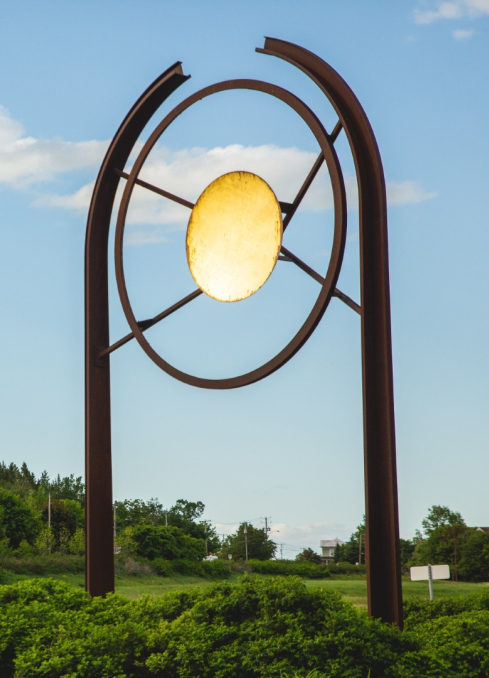
 André Fournelle
Corten steel, gold leaf, integrated lighting
Collection: Musée du Bas-Saint-Laurent
Carrefour giratoire, entrée ouest de la ville, boul. Hôtel-de-Ville - Inaugurated in 2010
Born in England in 1939 and raised in Montréal, artist André Fournelle trained in sculpture under Armand Vaillancourt and through workshops in the United States and Europe. In collaboration with sculptor Marc Boisvert, he established an experimental, collective foundry in Pierrefonds in 1967. A war orphan, Fournelle grounds his practice in a deep sensitivity to human fragility and a firm commitment to social and political engagement.
L’accueil takes the form of a tall arch, at the centre of which sits a disk covered in gold leaf. Encircled by a large ring, the vertical dome evokes a pupil or a distant planet. By day, it reflects the sun’s rays; by night, it mirrors the light from the ring’s integrated illumination. The work speaks to the artist’s enduring interest in fire and, by extension, all forms of incandescence.
The orange structure and the vivid yellow dome together make the work a striking focal point of the roundabout where it stands. Installed at the city’s western edge since 2009, L’accueil lives up to its name, offering a majestic welcome to all those arriving in Rivière-du-Loup.
Considering where the sculpture is placed, what do the title [“welcome” in English] and form suggest to you?
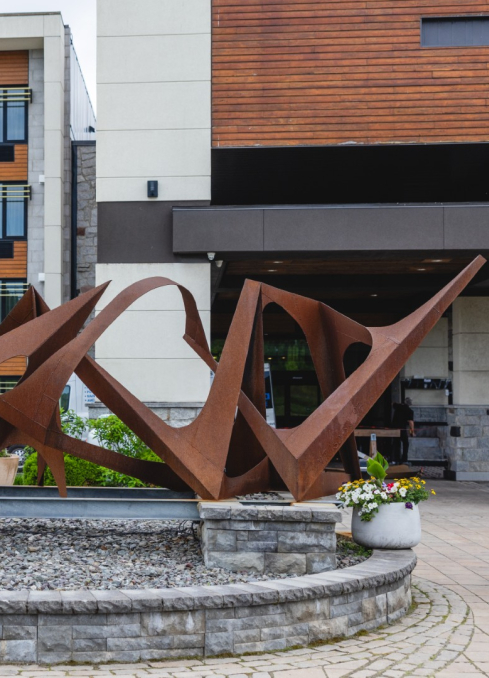 Yves Trudeau
Welded Corten steel
Collection: Musée du Bas-Saint-Laurent
311, boul. Hôtel-de-Ville - Inaugurated in 2010
Born in Montréal in 1930, Yves Trudeau (1930–2017) began studying art as a teenager and launched his sculpting career in the late 1950s. Actively involved in several professional organizations, he was a founding member of the Association des sculpteurs du Québec, playing a key role in the creation of the Musée d’art contemporain de Montréal.
The untitled sculpture, dubbed Enchevêtrement (or “entanglement”) is made from shapes cut out of steel sheets and then welded together. The resulting tangle appears to bear the marks of folding, as though the artist had bent the metal back onto itself, like a sheet of paper, to open up certain sections. Because of its intricacy, it is difficult to determine where the structure begins or ends, with its many elements interlaced in a complex web.
Driven by a fascination with movement, momentum and gravity, Trudeau created works that, rather than anchoring themselves to the ground, seem to lift skyward. Untitled (Enchevêtrement) is part of the artist’s ongoing exploration of mobility in sculpture. The piece’s numerous folds and creases, along with its many openings, give it a sense of lightness and fluidity, further enhancing its paper-like quality.
Born in Montréal in 1930, Yves Trudeau (1930–2017) began studying art as a teenager and launched his sculpting career in the late 1950s. Actively involved in several professional organizations, he was a founding member of the Association des sculpteurs du Québec, playing a key role in the creation of the Musée d’art contemporain de Montréal.
The untitled sculpture, dubbed Enchevêtrement (or “entanglement”) is made from shapes cut out of steel sheets and then welded together. The resulting tangle appears to bear the marks of folding, as though the artist had bent the metal back onto itself, like a sheet of paper, to open up certain sections. Because of its intricacy, it is difficult to determine where the structure begins or ends, with its many elements interlaced in a complex web.
Driven by a fascination with movement, momentum and gravity, Trudeau created works that, rather than anchoring themselves to the ground, seem to lift skyward. Untitled (Enchevêtrement) is part of the artist’s ongoing exploration of mobility in sculpture. The piece’s numerous folds and creases, along with its many openings, give it a sense of lightness and fluidity, further enhancing its paper-like quality.
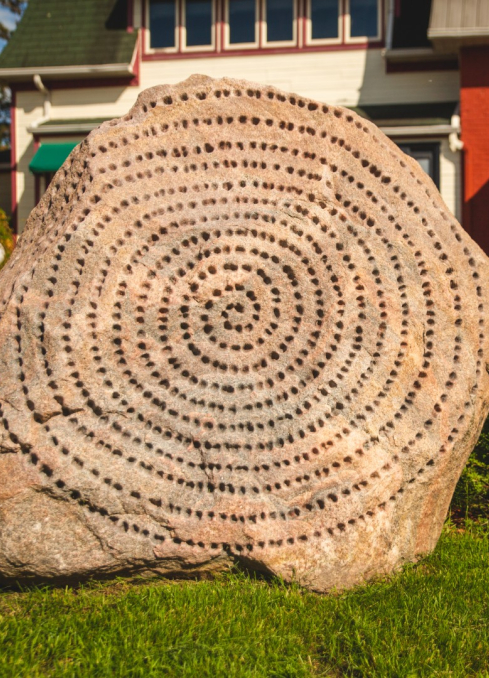 Bill Vazan
Sandblasted granite
Collection: Musée du Bas-Saint-Laurent
169, rue Fraser - Inaugurated in 2002
Born in Toronto in 1933, Bill Vazan studied at the Ontario College of Art and Design, the Beaux-Arts de Paris school and Sir George Williams University in Montréal, where he settled in 1957. Motivated by the desire to bring Montréal and Quebec into an international network, he was instrumental in founding Véhicule Art (Montréal) Inc., a major artist-run centre that showcased contemporary and experimental practices during the 1970s.
Rooted in the belief that nature and humanity are deeply interconnected, his artistic process draws inspiration from land art—an art movement that began in the 1960s focusing on creating artworks directly in and with the landscape. Throughout his career, Vazan has created an extensive body of carved stone works bearing symbolic motifs. These engravings often reference the marks left by human presence on the land.
The sculptures Dense and Vapour both feature winding patterns unfolding in multiple spirals and labyrinthine forms. These motifs suggest the serpentine path of a living being or its fossilized remains, while also echoing human movement, carving its way across the land and even into earth’s crust, the deepest substratum.
Which elements of nature does the movement in Vazan’s works evoke for you?
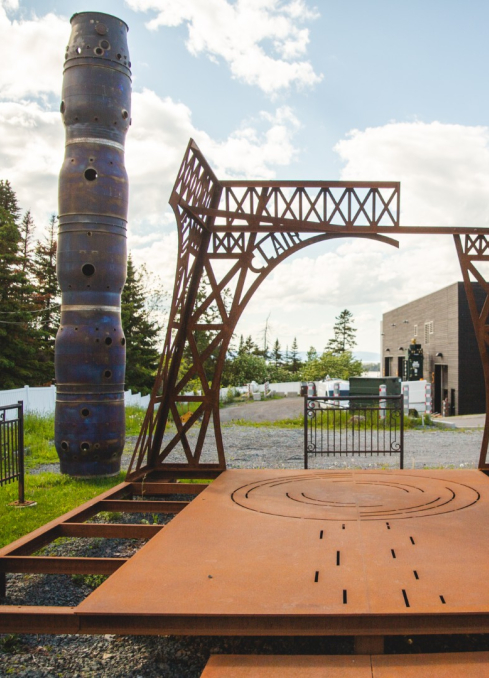 Dominique Rolland et Dominique Valade
Corten steel, titanium, cast aluminum lamppost, wrought iron fences, steel
Collection: Musée du Bas-Saint-Laurent
108, rue Fraser - Inaugurated in 2015
Dominique Rolland studied sculpture at the Université du Québec à Montréal from 1974 to 1979, before founding in 1983 the Centre des arts contemporains, a Montréal space dedicated to the diffusion and creation of monumental sculpture. His artistic practice is based on his strong interest in history. Dominique Valade holds a Master of Fine Arts degree (1994) and a PhD in Arts Studies and Practices (2004) from the Université du Québec à Montréal, where she focused on the reinterpretation of landscapes in sculptural work.
The installation Clair de lune takes the form of a whimsical agora inspired by the public squares of Ancient Greece—the heart of the city’s economic and political life. It consists of a platform framed by metal arches, reminiscent of the iconic Eiffel Tower, and two columns, with rounded edges and multiple portholes that evoke the submarines imagined by writer Jules Verne.
Wrought iron fences border the eclectic structure, where a hidden lighting system is visible through openings in the tallest column. Like something out of a science-fiction novel, Clair de lune merges the past and future, inviting the public to step into the scene and let their imaginations run wild.
This installation might remind you of a stage set. What scenes could unfold here? Who might the characters be
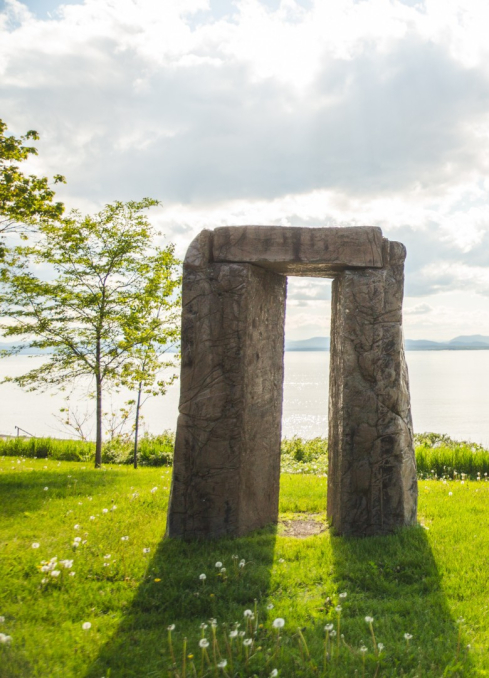 Tatiana Démidoff-Séguin
Vitrified cast cement
Collection: Musée du Bas-Saint-Laurent
Parc de la Pointe, rue Mackay - Inaugurated in 2003
Of Russian and French descent and born in Algeria, artist Tatiana Démidoff-Séguin (1935–2006) moved to Quebec in 1962 after studying art in Paris and Algiers. A co-founder of Espace, a magazine dedicated to contemporary sculpture, she became a key figure in Quebec’s sculpture scene through both her artistic practice and her deep commitment to the field.
Composed of two pillars topped with a lintel, Passage calls to mind the iconic stone structures of Stonehenge. Its surface bears the imprint of the moulding process, yet the glossy sheen achieved through vitrification—where cement is transformed into a glass-like material through melting and cooling—adds a refined, almost polished quality. The interplay between these contrasting techniques invites reflection on materiality and its impact on the human experience.
As the title suggests, the sculpture is meant to be walked through. It functions as a kind of portal to a distant past beyond the reach of memory, opening onto the river and echoing its timeless fusion of sand and water. Straddling the line between historical tableau and architectural object, Passage balances strength and fragility, all while evoking the passing of time and the traces it leaves behind.
This passage is meant to be walked through. What does it lead you to?
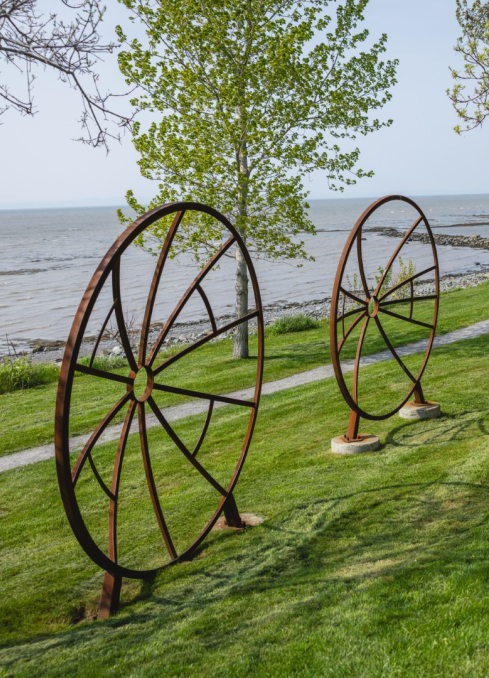 Michel Bernier et Myriam Kachour
Steel
Collection: Musée du Bas-Saint-Laurent
Parc de la Pointe, rue Mackay - Inaugurated in 2010
Artists Michel Bernier and Myriam Kachour share a deep appreciation for materials and the world around them. An ironworker, welder and sculptor, Bernier specializes in metalwork and makes large-scale sculptures for a number of artists. Kachour, meanwhile, creates visual art projects that often take the form of immersive installations. The artists have produced numerous works together.
Nature et protection consists of four rounded structures evoking various symbols, including a shield, windmill blades, a compass and a sundial. These steel forms divide the landscape into segments like a pie chart, their rigidity contrasting with the fleeting quality of the maritime backdrop. Erected in front of the river, the metal armatures impassively frame the shifting scenery, offering a range of viewpoints that invite new ways of seeing the world.
Intersected by the natural elements, the sculpture captures the energy of the sea winds and the cyclical whisper of the tides. Its anchored, silent presence invites contemplation, an escape from the clamour of daily life, to focus on the here and now in the presence of the river’s beauty. The sculpture becomes a quiet mediator between the self and the vastness beyond, forging a subtle connection between humanity and nature.
Each structure offers a unique view of the landscape. Try walking around and seeing them from different angles. Which one is your favourite?
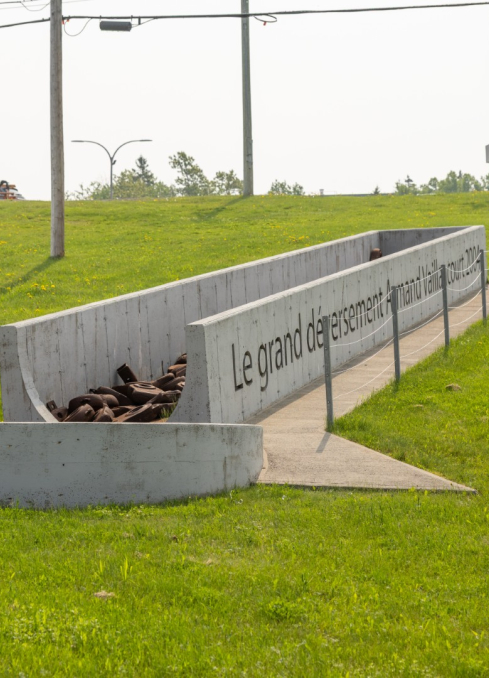
 Armand Vaillancourt
Concrete, steel
Collection: Musée du Bas-Saint-Laurent
Centre Hospitalier du Grand-Portage, côté boul. Armand-Thériault - Inaugurated in 2012
Born in Black Lake, in the Thetford Mines region, Armand Vaillancourt studied at the École des beaux-arts de Montréal in the early 1950s. An artist and committed activist, he has played a significant role in the development of sculpture in Quebec. Although essentially abstract, his works are deeply rooted in social convictions and political advocacy, which he has continuously renewed over nearly seven decades.
Combining a concrete structure with reclaimed steel components, Le grand déversement takes the form of a culvert filled with rusted objects, its upper section left open. Clearly industrial in appearance, the disordered elements spill into a circular tank reminiscent of a stormwater retention basin. These elements, all identical, are crusher hammers once used to pulverize a wide range of materials for recycling.
The work stands on the site of a former wooden trestle that once connected the Caldwell sawmill to the port and was used to transport lumber to the river. By turning the discarded remnants of our civilization into objects rich with social and historical meaning, Le grand déversement looks back on Rivière-du-Loup’s past while offering a sobering reflection on the planet’s environmental future.
In this sculpture referencing “a great spill,” what other objects could have taken the place of the crusher hammerheads?
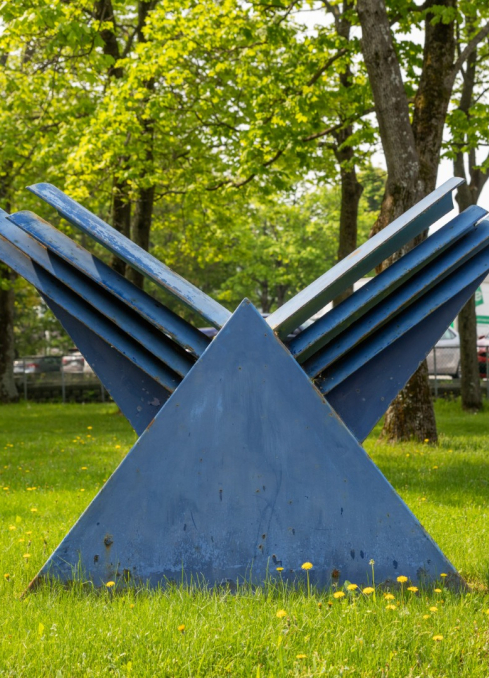 André Fournelle
Welded and painted steel
Collection: Musée du Bas-Saint-Laurent
51, rue Fraserville - Inaugurated in 2004
Born in England in 1939 and raised in Montréal, artist André Fournelle trained in sculpture under Armand Vaillancourt and through workshops in the United States and Europe. In collaboration with sculptor Marc Boisvert, he established an experimental, collective foundry in Pierrefonds in 1967. A war orphan, Fournelle grounds his practice in a deep sensitivity to human fragility and a firm commitment to social and political engagement.
The sculpture Les ailes de la liberté consists of two nearly identical pieces whose shape evokes the instant of take-off. Created in the context of the October Crisis, the work expresses the artist’s support for activists Pierre Vallières and Charles Gagnon, imprisoned during the turbulent events leading up to October 1970. The pieces represent two identities distinguished by their distinct colours but united by their shared form.
In this way, Les ailes de la liberté takes a clear stand in favour of social justice, at a time when many were defending freedom of expression and thought in the face of accusations levelled against their writings. The sculpture thus serves as an act of remembrance, preserving and transmitting an important perspective on Quebec’s history.
This piece is a tribute to two political prisoners from the October Crisis of 1970. How do these sculptures evoke freedom for you?
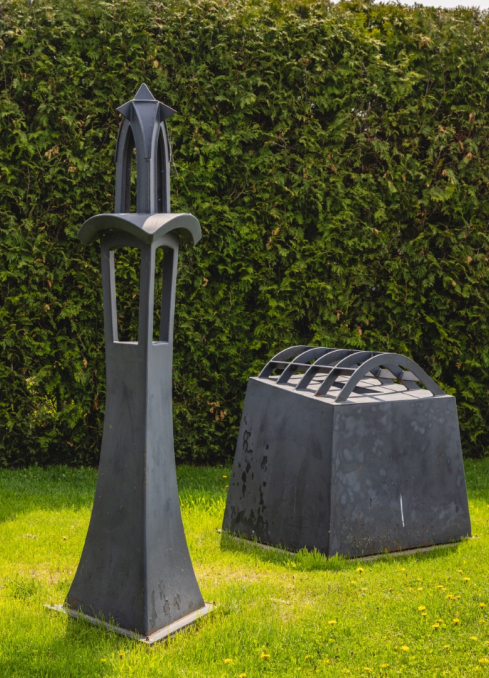
 Claude Millette
Painted steel
Collection: Musée du Bas-Saint-Laurent
Parc de la Croix, rue Sainte-Claire - Inaugurated in 2006
Born in Saint-Hyacinthe in 1957, Claude Millette studied at the École de sculpture de Saint-Jean-Port-Joli from 1975 to 1976, and then apprenticed with sculptors Jordi Bonet (1977) and Robert Poulin (1979). He soon developed a deep interest in metals and committed himself to an artistic approach driven by a constant desire to experiment with materials. He seeks to bring a sense of vitality to raw, rigid materials, particularly steel.
The Les cages de l’âme sculpture series comprises three works that each explore the theme of captivity in their own way. Painted black to emphasize the precision of their lines, the sculptures have a dual nature: they both confine and protect. In contrast to the sense of enclosure they evoke, their rounded forms rise skyward, as if gradually shedding their weight.
Les cages de l’âme 1, 2, and 3 are composed of arches and pointed forms that come together to create skeletal vaults and arcades. In referencing architecture, the sculptures speak to one another through the lightness of their framework and the solidity of their base. Their suggestive forms invite us to tap into our imagination, like gazing at clouds and discerning familiar shapes.
What might each of these cages contain?
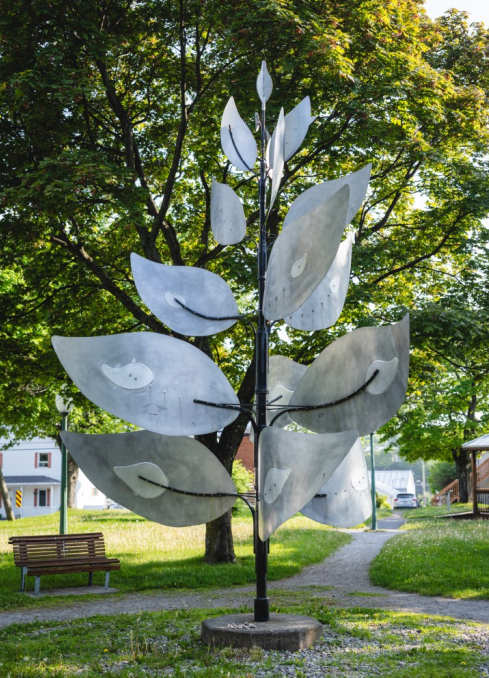 André Brassard
Brushed and polished steel and aluminum
Collection: Ville de Rivière-du-Loup
Parc Vézina, rue Vézina - Inaugurated in 2010
Born in Montréal in 1948, André Brassard studied visual arts at Université Laval in Québec City before beginning a teaching career at the Cégep de Rivière‑du‑Loup. While primarily focused on sculpture, his artistic practice reveals a strong affinity with ecological principles. Brassard is particularly interested in the forces of nature, living beings and movement.
The sculpture Arbor takes the form of a stylized tree bearing large metal leaves. Its title, referring to the Latin word for “tree,” serves as the root for many words. For example, “arborescence” is used to describe something that resembles a tree, which seems especially fitting for Brassard’s work. Arbor reflects the artist’s interest in modular structures and the effects of geometry.
Much like a mobile, the sculpture initially came to life with the movement of air. Then, after its leaves were immobilized, it is the viewer’s imagination that lends it a flowing presence and makes its leaves tremble. It appears, in a sense, to possess a life and history of its own, just like the majestic trees that surround it. Blending art and nature, Arbor is nestled within a leafy setting that weaves together cultural vitality, botanical harmony and the enduring resilience of the living world.
What does the tree symbolize to you, and how is that meaning reflected in this artwork?
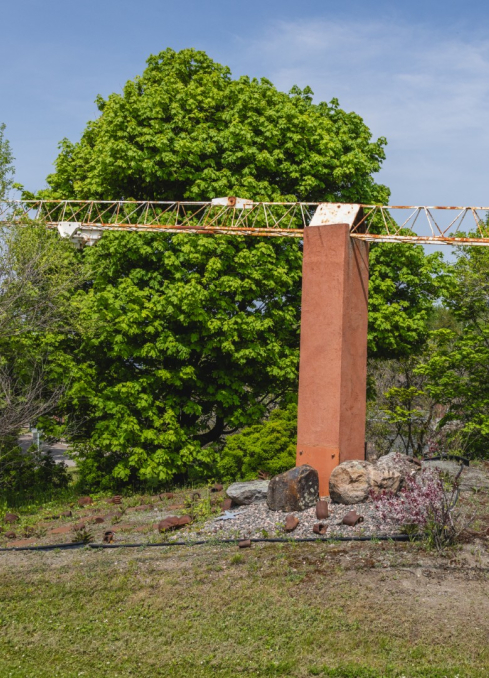 Tony Brown
Granite, steel, cast iron, aluminum, soil, plants
Collection: Musée du Bas-Saint-Laurent
En face du 147, rue Amyot - Inaugurated in 2003
Born in England in 1952, Canadian artist Tony Brown studied at the University of Manitoba in Winnipeg (1971–1975), the Nova Scotia College of Art and Design in Halifax (1975–1976), and Concordia University in Montréal (1977–1978). He later lived in France, where he taught at the École nationale supérieure des beaux-arts in Paris, and then in China, where he held a teaching post at Xi’an Eurasia University. Since the 1980s, Brown has created works that explore the impact of technology on human experience.
Through the Motions between the Stars takes the form of a crane, its horizontal arm extending over what resembles an archaeological dig. Fragments of statues, eerily reminiscent of ancient Greek sculpture, lie alongside large metal plates arranged like a chessboard. At the top of the crane, a star hangs suspended, imbuing the scene with a cosmic dimension. Remnants of a vanished civilization and traces of an industrial present lie quietly beneath the starry sky.
Together, these elements conjure the ruins of an imagined society. Through the Motions between the Stars reflects on the trials faced by humanity throughout history, and in particular, on the ways in which technology, initially designed to help us overcome hardship, can go awry.
Looking at the fragments on the ground, can you imagine what the statues might have looked like before they became ruins?
 André Fournelle
Granite, steel, wrought iron
Collection: Musée du Bas-Saint-Laurent
Parc des Chutes, rue Amyot - Inaugurated in 2003
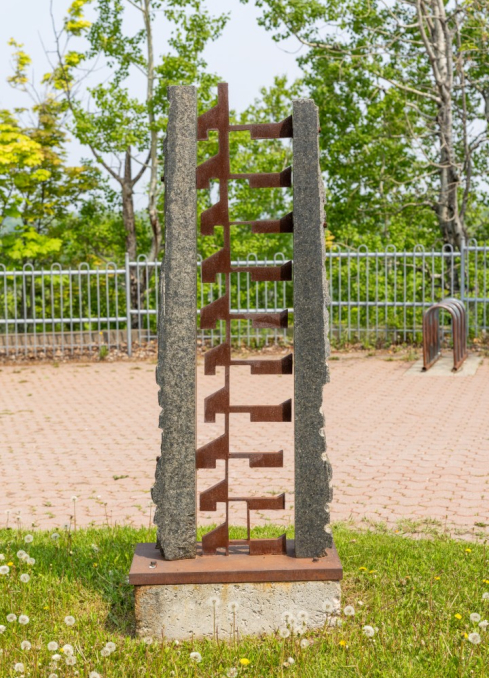
Born in England in 1939 and raised in Montréal, artist André Fournelle trained in sculpture under Armand Vaillancourt and through workshops in the United States and Europe. In collaboration with sculptor Marc Boisvert, he established an experimental, collective foundry in Pierrefonds in 1967. A war orphan, Fournelle grounds his practice in a deep sensitivity to human fragility and a firm commitment to social and political engagement.
The sculpture Scala—Italian for “ladder”—consists of two granite columns. Bearing the marks of extraction, they flank a metal structure with irregular forms. The green granite of the columns and the steel of the structure contrast in both weight and colour, while each evokes a connection to nature. This dialogue between materials reflects the artist’s fascination with materials and his relationship with the environment.
Following a stay in Italy in the late 1970s, during which he conducted research in art foundries, Fournelle began using Italian titles for some of his works. Scala is part of a series of sculptures centred on the motif of the column. Throughout the 1980s, the artist explored numerous variations on this architectural form, which recalls the technical and cultural achievements of Greco-Roman civilization.
What comes to mind when you consider the use of green granite and steel in Scala (Italian for “ladder”)?
 Gaétan Blanchet
Wood, metal, steel cables, motor
Collection: Musée du Bas-Saint-Laurent
Parc des Chutes, rue de la Chute - Inaugurated in 2003
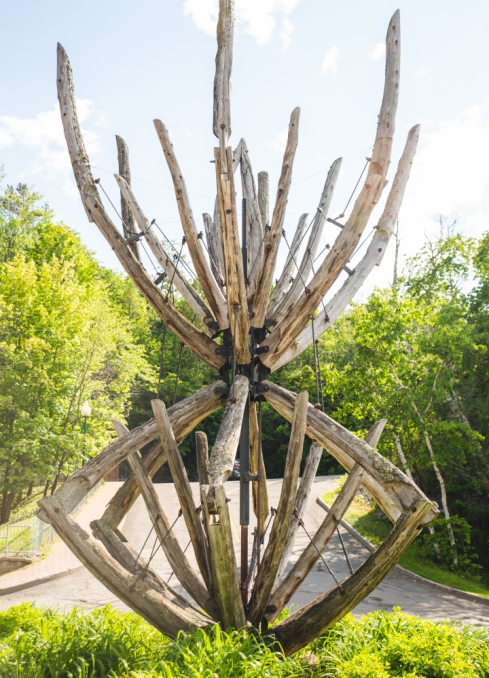
After studying at the École des beaux-arts de Québec, artist Gaétan Blanchet taught at the École des métiers de Rivière-du-Loup from 1967 to 1969, and then at the Cégep de Rivière-du-Loup from 1969 to 1996. An active member of the Bas-Saint-Laurent artist collective Au bout de la 20 until its dissolution in 1998, Blanchet marked the landscape of the region with his nature-inspired mobile sculptures.
Solstice is made up of 39 peeled cedar trunks, linked together by a system of steel cables and arranged to evoke the corolla of a flower. Originally, an electric mechanism allowed the sculpture to open and close. Through this cyclical movement, it echoed the intervals of time between the sunrise and sunset of the summer solstice (the longest day) and the winter solstice (the shortest day).
At Parc des Chutes, Blanchet’s work interacts powerfully with the history of the site, which was home to large sawmills. Solstice fuses the mechanical and the organic, inspired by the natural world’s underlying geometry. It highlights the balance of life and the power of nature, while also celebrating human intervention.
The sculpture originally included a mechanism that set it in motion. Step closer… Can you imagine how it might have moved?
 Robert Roussil
Wood
Collection: Musée du Bas-Saint-Laurent
Parc des Chutes, entrée rue Frontenac de l’autre côté de la passerelle - Inaugurated in 2013
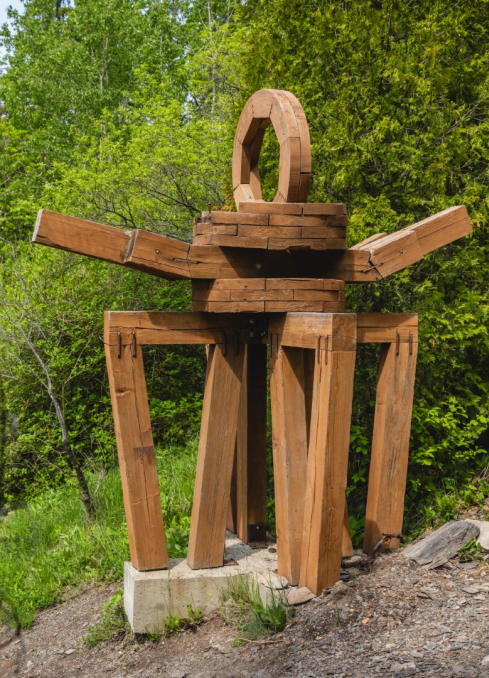
Born in east-end Montréal and later settling in Tourrettes-sur-Loup, France, where he lived from 1956 until his death, artist Robert Roussil (1925–2013) played a key role in the early development of modern sculpture in Quebec. Bold and avant-garde, Roussil consistently challenged the status quo and was a driving force behind Quebec’s artistic liberation, though not without stirring up some controversy along the way. His sculptural practice was grounded in a deep affinity for public space and a visceral love of nature.
This series of three sculptures embodies the major themes at the heart of his work: germination, blossoming, growth and energy. Part of a broader body of wooden sculptures built around overlapping circular forms, the works evoke the natural world as articulated, part-animal, part-plant creatures.
Carved from western yellow pine—a tree whose deep root system and towering crown mirror Roussil’s own concerns—the sculptures reach joyfully toward the sun while remaining firmly rooted in the earth. The trio punctuates the landscape with a rhythmic presence, reflecting the artist’s ingenuity and sparking a sense of wonder at nature’s raw vitality.
What kind of dialogue is created between these sculptures and their surroundings?
Set out on foot or by bike to discover some 40 works of art installed all around Rivière-du-Loup. This impressive collection brings together pieces by some of the biggest names in Canadian art.
Intervalle is an invitation to pause and awaken your senses during moments of stillness in the urban landscape.
Explore the trail on your own or join one of our guided walking tours, which leaves the Musée every Sunday at 11 a.m.!
$15 + tax. 5$ for kids (Free for children under 5).
(The fee also includes admission to the Musée.)
Guided Tours
The tour includes artworks in the Parc de la Pointe linear riverside park and a snack at the Café culturel de la Pointe. Maximum of four adults per tour, ages 18 and up.
Schedule and prices:
Saturdays 1:30–4:30 p.m. $45 + tax
Click HERE to book the 3-hour tour (via the De la Pointe Park)
Pick up a printed map of the Intervalle itinerary at the Musée du Bas-Saint-Laurent or the Rivière-du-Loup tourist information office.
To learn more, visit the Musée du Bas-Saint-Laurent or visit our website at mbsl.qc.ca.
.png)